
Weather observation field guide
How to Record Daily Weather Observations
Use a fixed observation time, consistent instruments and siting, explicit units, and notes about changes so today can be compared with tomorrow and with long-term records.
Quick answer Record at the same local time each day: current conditions, daily maximum and minimum temperature, precipitation for the defined 24-hour period, snow when applicable, wind or pressure if your instruments support them, sky and significant weather, instrument status, and any siting or schedule change. Keep raw observations separate from estimates and forecasts.
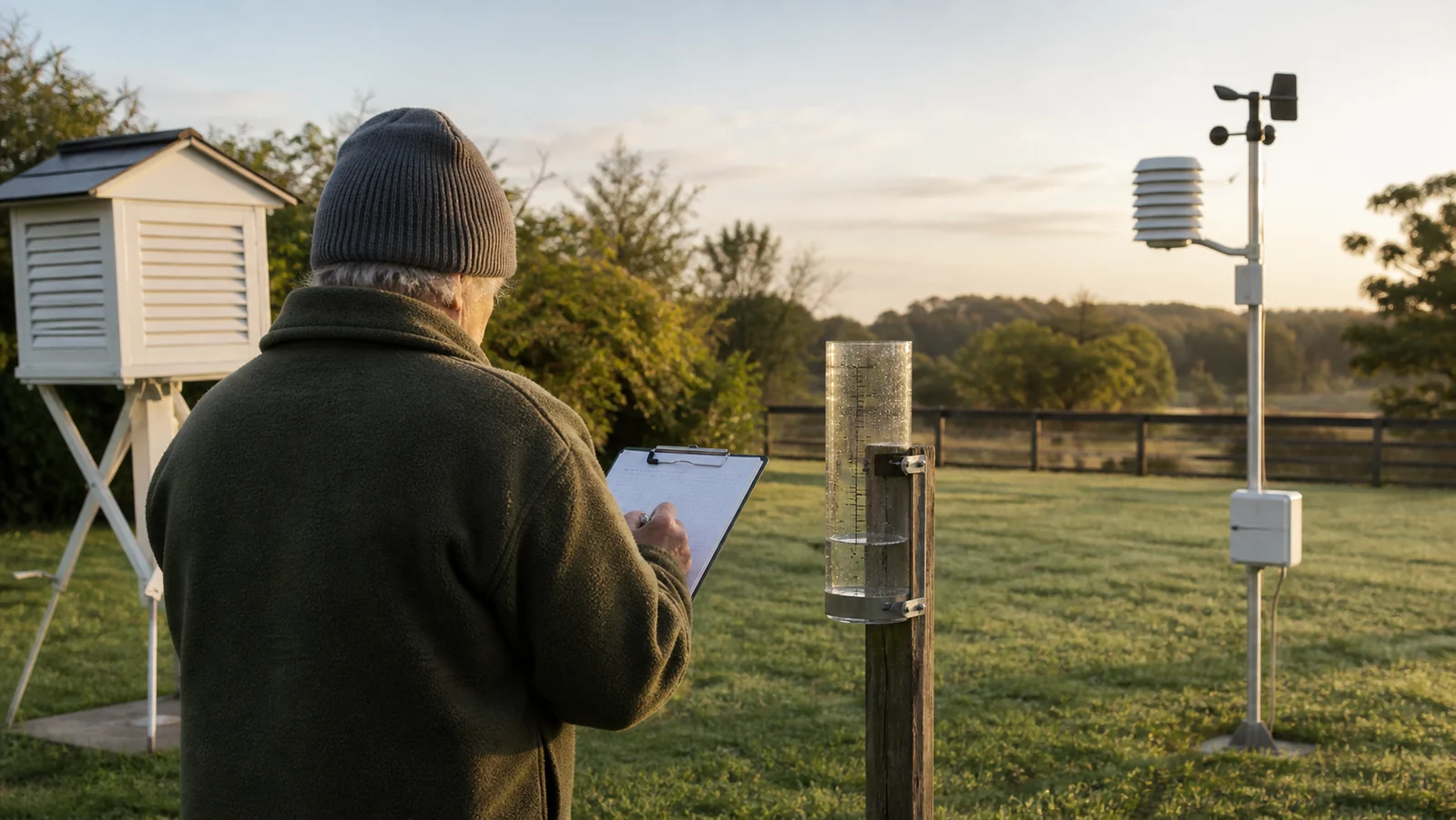
What to record each day
| Field | Record | Common mistake |
|---|---|---|
| Date and time | Observation time, time zone, and period represented | Mixing midnight-to-midnight with morning observations |
| Temperature | Current, maximum, and minimum with units | Using current temperature as the daily high or low |
| Precipitation | Gauge total for the defined interval | Combining multi-day catch without noting the period |
| Snow | New snowfall, total depth, and liquid equivalent separately | Calling total depth the storm snowfall |
| Conditions | Sky, visibility, wind, fog, thunder, hail, and impacts | Replacing observations with a forecast label |
| Metadata | Instrument or siting changes and missing data | Silently changing equipment or exposure |
Choose a consistent observation schedule
Many volunteer climate stations observe once daily at an assigned time, while automatic stations sample continuously and summarize by a specified day boundary. Either approach can work, but the observation day must be defined. A morning observer's maximum temperature may have occurred the previous afternoon. That is expected when records use a consistent climatological day.If an observation is late, missing, or spans more than 24 hours, record the actual interval. Do not invent a normal-time value after the fact. For snow, follow the distinct measurement and clearing schedule in our snow measurement guide.How to keep a weather journal or daily weather log
- Identify the station. Give it a stable name, coordinates or precise description, elevation, and time zone.
- Define the instruments and siting. Record sensor model, height, shielding, gauge type, and nearby exposure.
- Set the observation time and units. Keep them visible at the top of the log.
- Enter measured values first. Use a missing-data mark rather than guessing.
- Add concise notes. Document thunder, hail, fog, damage, maintenance, or unusual exposure.
- Back up the record. Keep a second copy and preserve the original units.
Copyable weather-journal template
| Field | Journal entry |
|---|---|
| Date and observation time | — |
| Current, high, and low temperature | — |
| Precipitation and snow | — |
| Sky and visibility | — |
| Wind | — |
| Significant weather | — |
| Instrument or site notes | — |
Completed example: August 7 at 7:00 a.m. CDT, 68°F current, 86°F high, 65°F low for the previous 24 hours, 0.24 inch of rain, partly cloudy with good visibility, calm wind, thunder observed at 6:15 p.m. August 6, gauge emptied after the 7:00 a.m. reading.
Quality-control checks
- Compare maximum, minimum, and current temperature for impossible relationships.
- Check the timestamp and battery/communication status before trusting an automatic value.
- Inspect precipitation gauges for blockage, splash, snow undercatch, or evaporation.
- Compare nearby stations while accounting for terrain, land cover, and observation time.
- Flag values changed after review. Do not overwrite the original without a trace.