
Best Portable Weather Stations for Field Use in 2026
These handheld meters measure conditions where you are standing. They are built for spot readings and temporary field work, not continuous backyard rainfall and remote home monitoring.
Affiliate disclosure: WXObservation may earn a commission from qualifying Amazon purchases at no extra cost to you. Amazon stock, sellers, colors, connectivity options, and included accessories can change. Confirm the exact model before ordering.
The three portable weather stations worth considering
The category is smaller than it once was. Several products in the old guide are discontinued or difficult to source, so this shortlist is limited to devices with a current manufacturer page and a matching Amazon product listing.

Kestrel 5500 Weather Meter
Best for: field observers who need a rugged meter, time-stamped logging, wind direction, and a temporary tripod station option.
- Measures wind speed and direction, temperature, humidity, pressure, altitude, dew point, heat stress, wet bulb, and related values.
- Stores more than 10,000 time-stamped data sets and supports optional LiNK connectivity.
- Works with a rotating vane mount for steadier wind direction and longer temporary observations.
Exact Amazon listing checked August 10, 2026. Seller and offer availability can change.
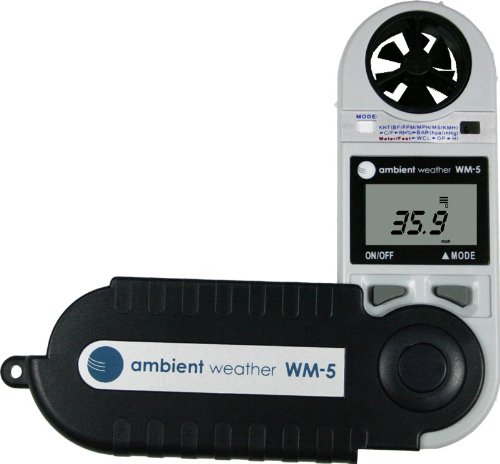
Ambient Weather WM-5
Best for: hikers, field crews, and weather watchers who want a broad sensor set without paying for logging or compass functions.
- Measures wind speed, temperature, humidity, barometric pressure, altitude, dew point, heat index, and wind chill.
- Uses a folding handle that keeps the hand farther from the environmental sensors during a reading.
- Supports recalibration and an optional small tripod for steadier measurements.
Exact Amazon listing checked August 10, 2026. Amazon showed no featured offer during that check, though the exact listing remained active.

INO Weather Pro
Best for: outdoor users who value portable lightning awareness more than wind measurement.
- Detects lightning and measures temperature, humidity, pressure, altitude, dew point, and heat index.
- Uses a color touchscreen and can transfer stored data through USB.
- Works without cellular service or an internet connection while taking local readings.
Exact Amazon listing checked August 10, 2026. Amazon showed no featured offer during that check, though the exact listing remained active.
Portable weather station comparison
| Model | Wind | Temperature and humidity | Pressure | Standout capability | Best fit |
|---|---|---|---|---|---|
| Kestrel 5500 | Speed and direction | Yes | Yes | Logging, compass, optional LiNK, and vane mount | Advanced field records and temporary station use |
| Ambient Weather WM-5 | Speed only | Yes | Yes | Broad measurements at a lower cost | General spot readings without logging |
| INO Weather Pro | No | Yes | Yes | Portable lightning detection and USB data transfer | Storm awareness when wind is not required |
None of these models includes a rain gauge. Feature names do not guarantee comparable accuracy or response time across brands.
What the specifications mean in real use
Closest to a temporary field station
The 5500 is the only pick here that combines wind direction, logging, a compass, and vane-mount use. Those features matter when a single instant reading is not enough. The added cost is difficult to justify for casual temperature and wind checks.
Simpler and easier to justify
The WM-5 covers the core weather values most people expect from a handheld meter. Its folding case helps reduce hand influence, though every compact meter still needs time and airflow to settle. The lack of direction and logging keeps it in the spot-reading category.
A hybrid rather than a full wind meter
The INO combines several environmental readings with lightning awareness in one device. That mix is useful for events, hikes, and field work where storm approach matters. Buyers who need wind should choose one of the other two meters.
A portable meter is not a home weather station
A handheld meter answers a local question at a specific moment. A home station is mounted outside and reports continuously to a console, app, or network. The two tools can complement each other, but they should not be compared as direct substitutes.
- You need conditions at a trail, work site, field, range, event, or temporary observation point.
- Wind, heat stress, humidity, pressure, or altitude must be checked where you are standing.
- The instrument must fit in a pocket or field bag and operate away from home Wi-Fi.
- You need rainfall, unattended records, overnight trends, and continuous backyard measurements.
- Family members need a console, remote app access, alerts, or a public weather network connection.
- You can install the outdoor sensors in a representative permanent location.
Start with the current home weather station picks when continuous household monitoring is the goal. Use the weather station reviews and comparisons when you need a deeper look at fixed systems and exact models.
How to choose a portable weather meter
List the measurements first
Wind speed alone is inexpensive. Humidity adds dew point and heat-index usefulness. Pressure supports weather trends and altitude calculations. Wind direction, logging, and lightning detection require more specialized hardware.
Separate readings from records
A current value answers what conditions are now. Logging shows how they changed. Choose logging only when you will review time-stamped data, document a site, or leave the meter on a stable temporary mount.
Check the exact SKU
Connectivity and accessories often vary within one model name. A Kestrel 5500 listing may be standard or LiNK enabled, and a vane mount may be included or separate. Match the seller description to the manufacturer SKU before buying.
Plan for maintenance
Replaceable impellers, field recalibration, batteries, charging, firmware support, and available service matter more over time than a long list of calculated values. Professional work may also require documented calibration.
How to obtain a useful field reading
Move the meter out of a pocket, vehicle, or conditioned building and give its sensors time to approach outdoor conditions. Keep the temperature and humidity sensors away from your hand, breath, wet clothing, exhaust, campfires, sun-heated rock, and direct sunlight. A fast reading immediately after a large environment change can describe the instrument more than the surrounding air.
Point the impeller into unobstructed airflow and keep your body behind the meter. Wind near trees, buildings, vehicles, slopes, and the ground may differ sharply from an open reference site. Record the observation height, exposure, averaging period, and location when comparing readings.
Pressure and altitude share one pressure sensor, so the reference setting matters. Humidity sensors need extra time after large temperature changes or moisture exposure. A tripod or vane mount improves consistency, but a stable mount cannot correct a poor site.
How this shortlist was refreshed
Each recommended product had to match a current manufacturer page and an exact Amazon product listing. The linked ASIN, model name, sensor set, connectivity wording, and current manufacturer status were checked on August 10, 2026. Products from the old guide were removed when the manufacturer identified a replacement, current support was unclear, or reliable new-product availability was too weak for a top recommendation.
Frequently asked questions
What is a portable weather station?
It is usually a handheld environmental meter that measures several local conditions. The term is not standardized, so buyers should compare the actual sensors, calculations, logging, and accessories.
Do portable weather stations measure rainfall?
Most pocket meters do not include a rain collector. None of the three products in this guide measures rainfall. A fixed home station or separate portable rain gauge is the better tool.
Which portable meter is best for wind direction?
The Kestrel 5500 is the only pick here with compass-based wind direction. A rotating vane mount helps keep it oriented into the wind for temporary station use.
Is the Kestrel 3500 or 5500 the better choice?
The 3500 is the simpler non-logging choice with a broad weather set. The 5500 adds logging, compass direction, a larger interface, optional LiNK, and vane-mount use. The dedicated Kestrel comparison explains every current step in the lineup.
Can a portable meter replace a weather app?
It measures the immediate microclimate instead of estimating conditions from a distant station or forecast model. A forecast app still provides radar, warnings, and future conditions that a handheld sensor cannot supply.
Sources and further reading
- Kestrel Instruments — Kestrel 5500 Weather Meter specifications
- Ambient Weather — WM-5 Handheld Weather Station
- Ambient Weather — WM-4 replacement notice
- INO Technologies — Weather Pro features and support
Compare weather radios, lightning detectors, cross-brand field meters, and Kestrel models in one place.