
Kestrel Weather Meters: Which Model Should You Buy?
Kestrel model numbers make sense once the decision is reduced to humidity, pressure, logging, and compass needs rather than buying the model with the longest feature list.
Affiliate disclosure: WXObservation may earn a commission from qualifying Amazon purchases at no extra cost to you. The Kestrel 2500 button currently goes to the manufacturer because the exact model is unavailable from Amazon. Availability, seller, color, connectivity, and included accessories can change. Confirm the exact model before ordering.
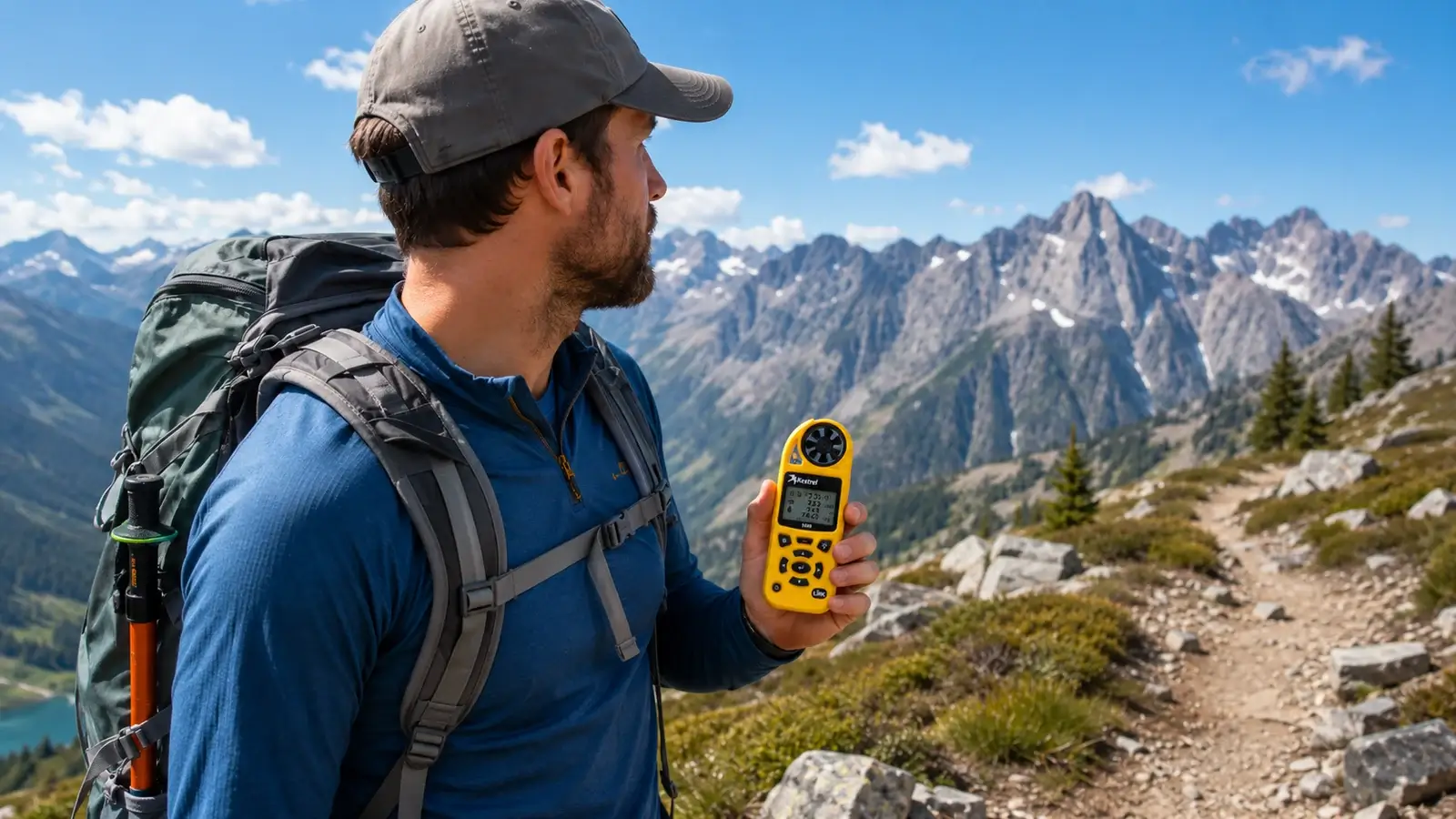
Match the Kestrel to four decisions
The first decision is whether relative humidity matters. The 2500 measures wind, temperature, pressure, and altitude but not humidity. The 3000 measures wind, temperature, humidity, dew point, and heat stress but not pressure. The 3500 combines the useful weather functions of both families in a basic handheld.
The second decision is logging. Basic 1000 through 3500 models show current, maximum, average, or calculated values according to model, but they do not provide the time-stamped data history of the 5 Series. The 5000 and 5500 can store more than 10,000 data sets. Optional LiNK versions transfer data and provide a mobile dashboard.
The third decision is wind direction. Every model in this guide measures wind speed. The 5500 adds a compass for direction, crosswind, and headwind or tailwind calculations. A stable direction reading requires careful orientation or the optional rotating vane mount. A compass label does not make an unstable hand position representative.
The fourth decision is specialized work. Fire-weather, agriculture, heat-stress, racing, professional airflow, and ballistics models add calculations or workflows for those fields. General weather observers should not pay for a specialized model unless its exact measurement or compliance need applies.
Want cross-brand alternatives? Use the portable weather-station guide to compare Kestrel with other handheld field meters.
Current Kestrel weather meter comparison
| Model | Key measurements and best fit |
|---|---|
| Kestrel 2500 | Wind speed and gust, temperature, wind chill, pressure, pressure trend, altitude, and clock. Best when pressure matters and humidity does not. |
| Kestrel 3000 | Wind speed and gust, temperature, wind chill, relative humidity, heat stress, and dew point. Best for athletic, field, and fire-adjacent spot checks where pressure is not needed. |
| Kestrel 3500 | Adds humidity, dew point, heat stress, wet-bulb temperature, pressure, trend, altitude, and clock in the broadest general basic model. |
| Kestrel 5000 | Advanced environmental measurements, a larger display, time-stamped logging, optional LiNK, and vane-mount compatibility. Best for repeatable surveys and records without compass-based direction. |
| Kestrel 5500 | The 5000 weather set plus compass, wind direction, crosswind, and headwind or tailwind. Best for a portable mini-station or direction-aware field work. |
Kestrel currently prices the 2500 and 3000 at the same level on its official site, which makes the sensor choice more important than a budget ladder. The 3500 costs more because it combines humidity and pressure functions. The 5000 and 5500 cost more for their 5 Series display, logging, connectivity options, and advanced workflow.
The basic 2500, 3000, and 3500
Kestrel 2500
Choose the 2500 for hiking, field elevation work, weather trend awareness, and wind checks when humidity is unnecessary. Pressure trend and altitude rely on correct reference settings and interpretation. It is not a humidity or heat-index meter.

Kestrel 3000
Choose the 3000 for relative humidity, dew point, heat stress, and wind. Athletic trainers, outdoor workers, and observers focused on hot or humid conditions gain more from it than from a pressure sensor. It lacks altitude and barometric trend.

Kestrel 3500
Choose the 3500 when one non-logging instrument must cover wind, temperature, humidity, dew point, wet bulb, heat stress, pressure, altitude, and pressure trend. It is the most straightforward general-weather choice below the advanced logging series.
Basic models use a small external temperature sensor and a user-replaceable impeller. They are waterproof and designed for field use, but a durable housing does not eliminate measurement technique. Body heat, sun, a warm vehicle, a wet sensor, and a sheltered wind position can all bias the displayed condition.
Kestrel 5000 versus 5500
The Kestrel 5000 is the practical advanced choice for environmental surveys, research, safety documentation, agriculture, expeditions, and repeated site comparison. It logs more than 10,000 time-stamped sets. LiNK is optional, not standard on every SKU. A non-LiNK meter still logs internally, while phone transfer and the remote mobile dashboard require the correct LiNK model or accessory path.
The 5500 adds a digital compass and wind-direction calculations. With the rotating vane mount on a tripod, the meter can face into the wind for continuous speed, direction, and environmental logging. The LiNK version can provide a remote dashboard within the manufacturer-rated short-range connection. This is useful for a temporary field station, not a permanent unattended replacement for a weatherproof home station.

- Time-stamped environmental logging is required.
- Pressure, humidity, density altitude, and broad weather values matter.
- Wind speed is needed but compass direction is not.
- A larger screen and optional LiNK justify the price.

- Wind direction and compass functions are required.
- Crosswind or headwind and tailwind calculations matter.
- A rotating vane mount will be used for a temporary station.
- The added features will be used often enough to justify the cost.
How to obtain a representative field reading
A handheld meter measures the air moving through and around its sensors at that moment. Remove it from a pocket, warm vehicle, or conditioned building and allow the instrument to approach ambient conditions. Hold it away from the body, breath, sun-heated surfaces, exhaust, campfires, and vehicle airflow. Shade is important for air temperature because direct solar heating affects the instrument.
For wind speed, face the impeller into the flow and keep fingers, the case, and nearby objects from blocking it. A quick maximum gust is not the same statistic as a timed average. Record the averaging interval, height, location, and exposure when comparing observations. Wind in a sheltered yard, at shoulder height, will not match an airport anemometer above open terrain.
Humidity and dew point need sensor equilibration. A meter carried in a warm pocket may take time to settle in cold air. Moisture on the sensor can produce unusual values. Pressure and altitude depend on reference settings because weather pressure changes and elevation calculations are linked. Use station pressure when the workflow requires raw local pressure and set reference altitude carefully when displaying barometric pressure.
Logging does not correct poor exposure. A Kestrel on a tripod near hot pavement will create a detailed record of that hot microclimate. Choose a representative site, use a radiation shield where appropriate for longer temperature work, and document every setup change.
Maintenance, calibration, and ownership
The impeller is designed to be replaceable. Inspect it for grit, hair, ice, and damage when wind readings become slow or erratic. Spin it gently and avoid lubricants unless the manual specifically directs their use. Keep the temperature and humidity sensor openings clean and allow the meter to dry after wet use before long storage.
Kestrel offers field humidity recalibration for applicable models, factory service, and calibration options including NIST-traceable work for supported measurements. A certificate is valuable when a job, research protocol, or audit requires traceability. Casual weather observation usually benefits more from correct technique and periodic comparison than from paying for documentation that the use does not require.
Record the serial number, battery changes, firmware version for 5 Series models, calibration events, and impeller replacement. Update LiNK firmware through the supported current path. The 4000 Series was discontinued in 2015, so marketplace listings for a 4500 should not be confused with the current 5000 or 5500.
Frequently asked questions
Which Kestrel measures both humidity and pressure without logging?
The Kestrel 3500 is the broad general-weather model in the basic series. It combines relative humidity and related values with barometric pressure, trend, and altitude.
What is the difference between Kestrel 5000 and 5500?
Both provide advanced environmental measurements and logging. The 5500 adds a compass, wind direction, crosswind, and headwind or tailwind functions.
Does every 5 Series meter include Bluetooth?
No. LiNK connectivity is optional on relevant 5000 and 5500 SKUs. Confirm the exact model code before buying.
Can a Kestrel replace a home weather station?
It can serve as a portable spot instrument or temporary logging station. It does not provide the same unattended long-term mounting, household display, rain collector, and continuous network setup as a complete home station.
Sources and further reading
- Kestrel — basic 1000 through 3500 comparison chart
- Kestrel — 2500 Weather Meter
- Kestrel — 3000 Weather Meter
- Kestrel — 3500 Weather Meter
- Kestrel — 5000 Environmental Meter
- Kestrel — 5500 Weather Meter
- Kestrel — current comparison resources
Compare weather radios, lightning detectors, cross-brand field meters, and Kestrel models in one place.