
Davis Vantage Vue Review: Is It Still Worth the Premium?
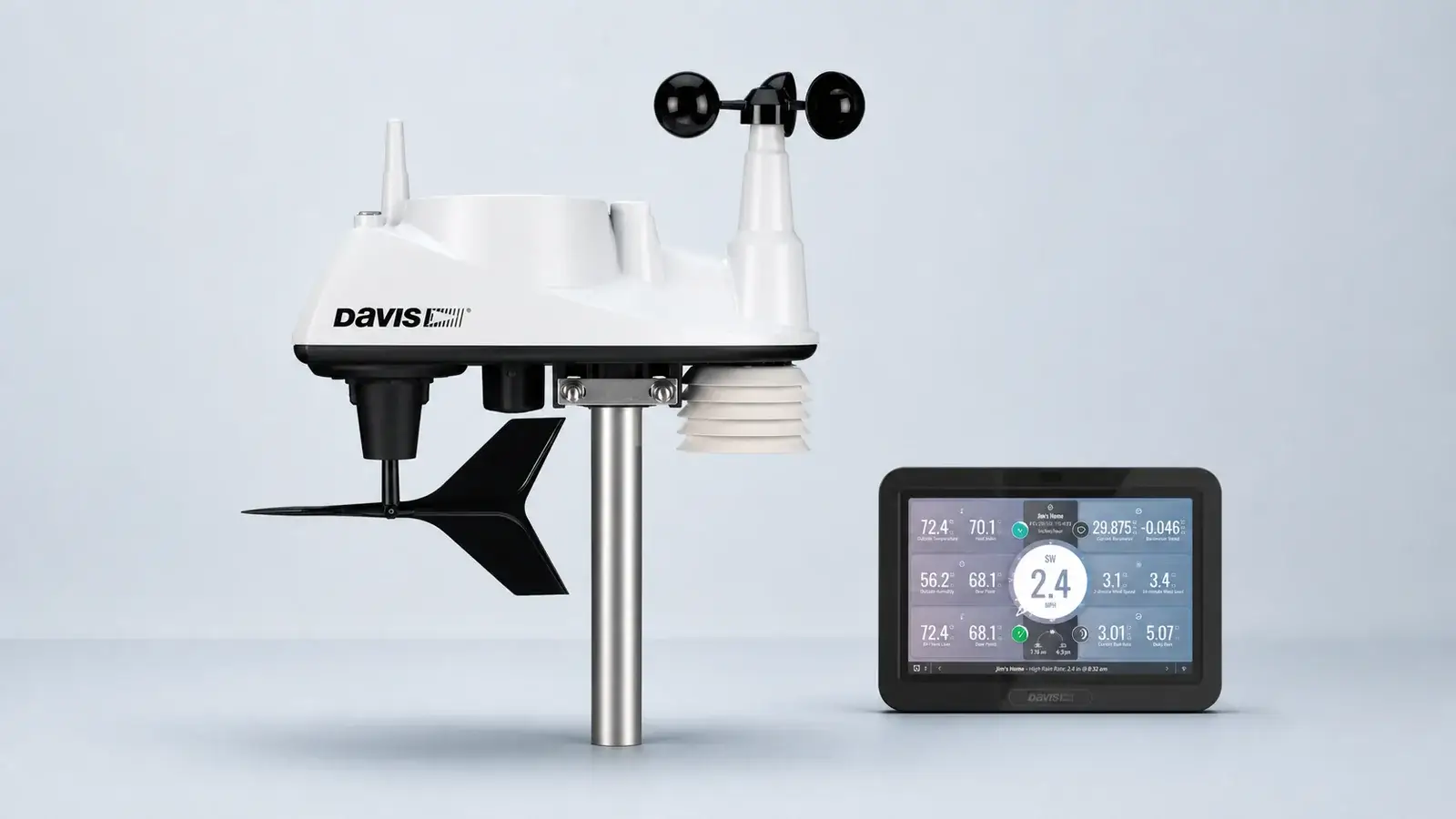
The current Vantage Vue keeps the compact, fast, long-range sensor suite that built its reputation and pairs it with a modern WeatherLink Console. The question is whether durability, radio performance, and the Davis ecosystem justify the price and siting compromise.
Affiliate disclosure: WXObservation may earn a commission from qualifying Amazon purchases, at no additional cost to you. Availability, seller, bundle contents, and prices can change, confirm the current listing before ordering.

Davis Vantage Vue 6242
Choose the current complete system when fast updates, a 1,000-foot line-of-sight radio rating, a rugged integrated suite, and a modern local/cloud console justify the premium.
Confirm the listing is the current 6242 US-frequency package with 6357 sensor suite and 6313 WeatherLink Console—not an old 6250 bundle, sensor-only 6357, or console-only 6313.
Current 6242 versus legacy 6250
The existing WXObservation URL includes “6250,” and that legacy query still has value. The product package has changed. The old 6250 combined the 6357-style Vantage Vue sensor suite with Davis’s classic monochrome console. The current complete US system is 6242: sensor suite 6357 plus WeatherLink Console 6313. The outdoor measurement concept is continuous, but the console, Wi-Fi, interface, storage, and online experience are substantially different.
Classic console package
The older console is a durable local display, but internet connectivity historically required a separate logger or WeatherLink device. It should not define a 2026 review of the current package.
WeatherLink Console package
The 6313 adds an HD touchscreen, built-in Wi-Fi, local historical analysis, alarms, dashboard customization, and direct WeatherLink Cloud publishing.
Vantage Vue specifications at a glance
| Decision point | Current 6242 system |
|---|---|
| Outdoor suite | Self-contained 6357 measuring outdoor temperature/humidity, wind speed/direction, and rainfall. |
| Indoor and derived data | Console provides indoor temperature/humidity and barometric pressure. System calculates dew point, wind chill, heat index, rain rate, and other indices. |
| Update cadence | Davis states real-time updates as fast as 2.5 seconds, its current Vue page lists wind at 2.5 seconds and temperature/humidity at 10 seconds. |
| Radio range | Frequency-hopping spread-spectrum link rated up to 1,000 ft/300 m line of sight. |
| Outdoor power | Solar power with a supercapacitor for night operation and a 3-volt lithium backup battery. |
| Console | 6313 HD touchscreen with local records, graphs, alarms, forecasts, and support for multiple Davis transmitters. |
| Internet | Built-in Wi-Fi can upload to WeatherLink Cloud. Basic local sensor reception does not require Wi-Fi. |
| Mounting | Included suite hardware attaches to a compatible pole. The mast, tripod, or complete mounting structure can be separate. |
| Warranty | Current sensor-suite product material lists a one-year manufacturer warranty. |
What the Vantage Vue measures well
The Vue’s appeal is not a long feature checklist. It is a compact package engineered around frequent updates, robust radio communication, weather-resistant construction, and a long-lived ecosystem. Wind response is notably fast for a consumer station. The tipping-spoon rain collector resolves 0.01-inch increments on the US version, and the sensor housing is designed for continuous outdoor exposure.
Davis publishes strong specifications, but published capability is not the same as guaranteed field performance. “2.5-second updates” does not mean every variable changes at that cadence, and “1,000 feet” is a line-of-sight radio rating, not a promise through every wall, metal roof, or tree line. Those numbers remain meaningful advantages when presented with their conditions.
The all-in-one placement compromise
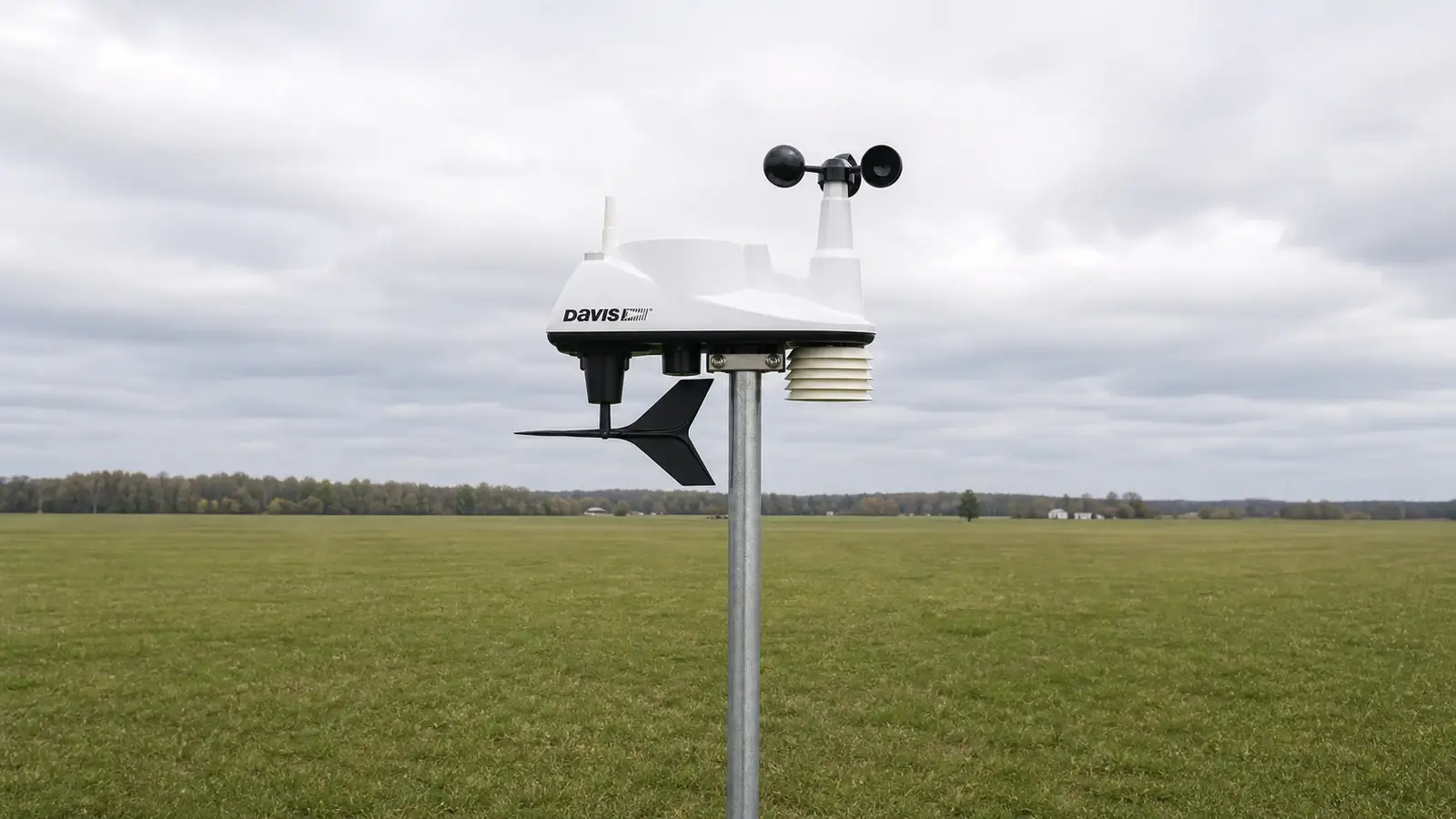
Vantage Vue is easy to install because wind, rain, temperature, and humidity share one suite. The same design prevents ideal independent siting. A high, clear position helps wind but can expose temperature to roof heat and make rain-gauge maintenance difficult. A lower yard position can represent temperature and rain better but under-read wind among buildings and trees.
For a typical home, an open mast over representative ground is defensible when local temperature, humidity, and rain matter more than standard-height wind. If wind is the priority, the separable anemometer of a Vantage Pro2 is the stronger architecture. Do not calibrate a sheltered Vue until obstruction, height, comparison exposure, and maintenance have been considered.
- Wind: compare only with stations at similar height and exposure, fast updates cannot overcome shelter.
- Temperature and humidity: keep the passive shield away from roof heat, walls, exhaust, and reflective pavement.
- Rain: level the suite and keep the tipping spoon and collector clear of debris and insects.
- Pressure: verify elevation and the difference between raw station pressure and sea-level adjustment.
- Radio: use the diagnostic reception percentage, not one momentary signal label, to judge link quality.
WeatherLink Console: the biggest modernization
The current WeatherLink Console changes the ownership experience more than the outdoor suite. It is a dedicated HD touchscreen with customizable tiles, local records, alarms, forecasts, and historical graphs. Davis says it can receive data from up to eight transmitters or stations within the compatibility rules, creating a broader sensor network than the compact Vue housing alone suggests.
The console receives local Davis radio data without Wi-Fi. Wi-Fi is still important for accurate time, firmware updates, WeatherLink Cloud uploads, remote dashboards, and supported integrations. This distinction prevents a common misconception: a router or internet outage can interrupt the cloud path without stopping local sensor reception.
WeatherLink’s free and paid service tiers, export options, API access, and third-party integrations can change. Readers who need unrestricted local automation or long-term bulk export should verify the current plan and interface before purchase rather than assuming every screen and data path is included forever.

Davis 6313 WeatherLink Console
Compatible older wireless Vantage Vue systems can add the 6313 without replacing the outdoor sensor suite. The console can receive the Vue radio signal directly, or an older Vue console can retransmit on an unused transmitter ID. This brings a color touchscreen, local graphs, Wi-Fi, and WeatherLink Cloud access to many 6250-era installations.
Check before buying: match the console to the station’s radio region. The 6313 is for compatible wireless systems, not a plug-in replacement for cabled equipment. See Davis’s retransmission instructions.
Product Link: Check Availability on Amazon
Power, maintenance, and long-term ownership
The outdoor suite’s solar panel charges its internal energy-storage path for daytime and night operation, while a 3-volt lithium cell provides backup. Davis says the backup can last several years depending on solar charging and conditions. The console is AC powered with battery backup. Follow the current manual for battery type and replacement rather than substituting a physically similar cell.
Seasonal maintenance includes clearing the rain collector and tipping spoon, wiping the solar panel, inspecting the passive shield, confirming the vane and cups move freely, checking the mast and fasteners, and looking for nests, insects, algae, or plant growth. Recheck level after severe wind, ice, or any mast work.
Long-term owner reports are one of Vue’s strongest reputation signals, but anecdotes do not prove a universal service life. Current WeatherLink Console reports also include individual connection, firmware, and support frustrations. Use those as questions to ask—frequency region, reception, Wi-Fi requirements, account path, firmware, and return support—not as a fabricated failure rate.
Expandability: more than the housing, less than Pro2 freedom
The integrated Vue suite itself is not a modular field station, but the WeatherLink Console can receive compatible additional Davis transmitters and sensors within its system limits. That can include another station or specialized Davis transmitters. The console’s “80+ sensors” marketing refers to supported network combinations, not 80 instruments inside one Vue suite.
Vantage Pro2 remains the better architecture when the anemometer must be separated from temperature and rain, a fan-aspirated shield is required, or solar/UV and specialized field placement are central. Vue is the compact, simpler path. Pro2 is the configurable field-system path.
Who should buy Vantage Vue?
- Fast wind response and long rated radio range matter.
- You want a compact, weather-resistant suite with a long-lived platform.
- A modern local console and WeatherLink Cloud fit your workflow.
- You prefer a simpler installation over independently sited instruments.
- You are willing to pay for build, radio, and ecosystem rather than the longest feature list.
- Choose Vantage Pro2 when a separable anemometer or field-system flexibility is essential.
- Choose WS-2000 when display and optional-sensor value matter more than Davis radio range.
- Choose AcuRite Atlas when aspiration, UV/light, and optional lightning are priorities at a lower cost.
- Choose an open local-data platform when cloud-plan and API constraints are unacceptable.
Pros and limitations
- Fast variable-specific updates, especially wind.
- Exceptional 1,000-foot line-of-sight radio rating.
- Compact, corrosion-resistant integrated suite.
- Modern WeatherLink Console with strong local analysis.
- Mature Davis parts, documentation, and sensor ecosystem.
- High purchase price for a compact core sensor set.
- Integrated housing imposes a siting compromise.
- No independent anemometer placement like Vantage Pro2.
- Cloud, export, and API needs require current plan verification.
- Current 6242 guidance differs substantially from old 6250 reviews.
Frequently asked questions
Is Davis Vantage Vue 6250 discontinued?
The old 6250 classic-console bundle is discontinued. The Vantage Vue family remains current as the 6242 complete system with 6357 sensor suite and 6313 WeatherLink Console.
Does Vantage Vue need Wi-Fi to work?
No for local sensor reception and display. Wi-Fi is needed for accurate time, firmware updates, WeatherLink Cloud uploads, remote access, and supported online features.
How often does it update?
Davis states updates as fast as 2.5 seconds. Its current Vue page specifies 2.5-second wind and 10-second temperature/humidity cadence. Do not assume every variable changes every 2.5 seconds.
How far can the sensor be from the console?
Davis rates the frequency-hopping link up to 1,000 ft/300 m line of sight. Walls, metal, terrain, vegetation, interference, and antenna placement can reduce practical range.
Is Vantage Vue more accurate than cheaper stations?
It has strong published specifications, fast updates, and a durable design, but no brand can overcome a poor site. Compare individual sensor tolerances and installation architecture rather than relying on one global accuracy label.
Should I buy Vantage Vue or Vantage Pro2?
Choose Vue for compact installation, lower Davis-system cost, and core observations. Choose Pro2 when independent anemometer placement, fan aspiration, solar/UV options, or a more configurable field system justify the premium.
Bottom line
Vantage Vue is still a compelling premium compact station when fast updates, long radio range, rugged construction, and the Davis platform matter. The current 6242 package finally pairs that outdoor reputation with a modern console. Its price and integrated siting compromise are real, and old 6250 connectivity criticism no longer describes the current bundle. Buy Vue for a durable, simple Davis system, buy Pro2 when measurement placement must be separated.
Primary sources
Specifications and compatibility were checked against current Davis product pages, manuals, and support documentation in August 2026. Owner reports are used only as anecdotal context.
- Davis Vantage Vue 6242 with WeatherLink Console
- Davis Vantage Vue 6357 sensor suite
- Davis Vantage Vue product-family page
- Davis WeatherLink Console 6313
- Davis WeatherLink Console FAQ
- Davis Vantage Vue FAQ
- Davis Vantage Vue specification sheets
Related Station Guides
Use these practical guides to get more reliable readings and a better ownership experience:
- Installation and siting — Place the sensors where buildings, pavement, trees, and roofs will not bias the readings.
- Weather station accuracy — Separate normal instrument limits from fixable siting, setup, and maintenance errors.
- Maintenance checklist — Keep the rain collector, radiation shield, wind sensors, batteries, and mounts in working order.