
Ambient Weather WS-2000 vs. WS-2902
The two stations use essentially the same outdoor sensor array. The real buying decision is whether the WS-2000’s much better display, separate indoor sensor, and broader expansion options justify its higher price.
The WS-2902 gives a first-time owner the same core outdoor observations for less money. The WS-2000 is the better long-term platform when you want a sharper screen with wider viewing angles, indoor readings that are not tied to the console’s location, or optional sensors for more areas and more types of conditions. Paying more does not buy a more accurate version of the shared outdoor array.
Affiliate disclosure: WXObservation may earn a commission from qualifying Amazon purchases, at no additional cost to you. Product availability, seller, bundle contents, and prices can change, confirm the current listing before ordering.
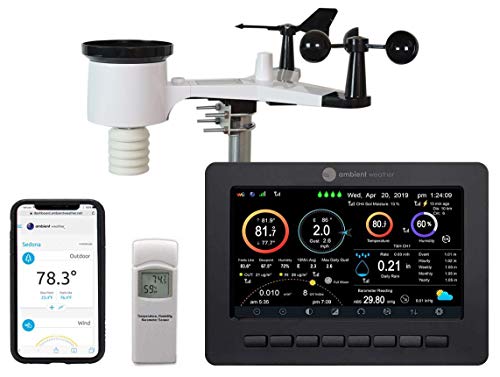
Ambient Weather WS-2000
Choose it for the high-definition TFT console, a separate WH32B indoor temperature-humidity-pressure sensor, direct console menus, and the broader range of optional environmental sensors.
Confirm the listing includes the console, WH65-style outdoor array, and separate indoor sensor.
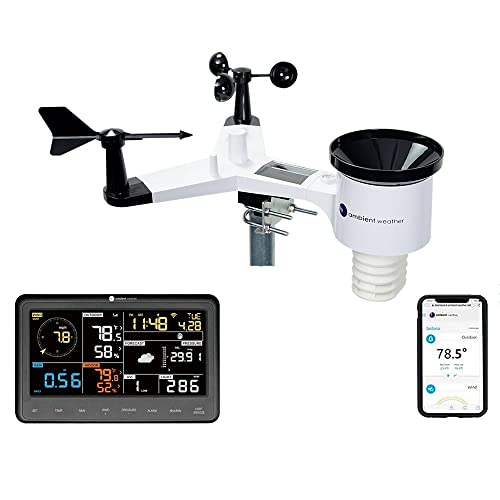
Ambient Weather WS-2902
Choose it when you mainly want wind, rain, outdoor temperature and humidity, UV, solar radiation, a local display, and internet access without paying for the WS-2000 console and wider sensor ecosystem.
Check the exact console revision and included accessories because the WS-2902 line has changed over time.
WS-2000 vs. WS-2902 at a glance
| Decision point | WS-2902 | WS-2000 |
|---|---|---|
| Outdoor measurements | Wind speed and direction, rainfall, outdoor temperature and humidity, UV, and solar radiation | The same core outdoor measurements from the same basic WH65/Osprey-style array |
| Display | Color-film LCD, useful but more sensitive to viewing angle | High-definition full-color TFT with light/dark backgrounds and broader viewing angles |
| Indoor readings | Temperature, humidity, and pressure sensors are normally inside the console | Included separate WH32B sensor lets the console and indoor measurements live in different places |
| Optional sensors | Supports a limited group. Exact compatibility depends on console revision | Supports a broader range, including more temperature/humidity channels and specialized environmental sensors |
| Internet | Wi-Fi connection to the Ambient Weather Network, setup steps vary by revision | Wi-Fi connection to the Ambient Weather Network with network settings entered through the console menus |
| Mounting | Same outdoor-array mounting needs | Same outdoor-array mounting needs |
| Array update and range | 16-second outdoor updates, rated up to 300 feet line of sight | 16-second outdoor updates, rated up to 300 feet line of sight |
| Power layout | Solar-assisted outdoor array with backup batteries, display normally uses its AC adapter | Solar-assisted outdoor array with backup batteries, display normally uses its AC adapter |
| Best fit | Value-focused first station or straightforward backyard monitoring | Enthusiast setup, multiple monitored areas, or anyone prioritizing the local display |
What is actually the same?
The most important similarity is easy to miss: the current WS-2000 and WS-2902 packages use the same basic outdoor array architecture. Ambient identifies the WS-2000 array as the WH65 family—the same familiar Osprey-style array associated with the WS-2902 line. It measures outdoor temperature and humidity, wind speed and direction, rainfall, UV, and solar radiation. The consoles also calculate familiar derived values such as dew point, heat index, and wind chill. Both packages use a 16-second outdoor update interval and are rated for up to 300 feet of line-of-sight array-to-console range. Walls, metal, and other obstructions can reduce that distance.
That means the WS-2000’s higher price is not a fee for a fundamentally different rain gauge or a more advanced anemometer. If both arrays are mounted in the same exposure, maintained the same way, and configured correctly, their outdoor measurement capability is essentially alike. Siting, leveling the rain collector, clearing obstructions, and routine maintenance will influence data quality more than choosing one of these two consoles.

- Same core array: both cover the weather variables most home observers want.
- Same mounting decision: neither model fixes a roof-heated, tree-shadowed, or poorly leveled installation.
- Same cloud goal: both can publish observations through Wi-Fi to the Ambient Weather Network.
- Same practical accuracy lesson: the WS-2000 console does not make the shared outdoor array inherently more accurate.
For installation help, use the weather station siting guide before choosing hardware, then see our weather station mounting ideas.
What does the WS-2000 premium buy?
A much better local display
The clearest upgrade is the console. The WS-2902 uses a color-film LCD that presents a useful overview, but its contrast and readability depend more heavily on viewing angle and room lighting. The WS-2000 uses a high-definition TFT screen with a more polished, information-dense interface and selectable light or dark backgrounds. It is still operated with physical buttons—not touch—but its graphical menus make calibration, sensor identification, alarms, and network settings easier to manage locally.
If you normally check conditions on the Ambient Weather Network app or website, the display difference may matter less. If the console will sit across a kitchen, office, classroom, or workshop and serve as the household’s primary weather dashboard, the WS-2000’s screen is the strongest reason to spend more.
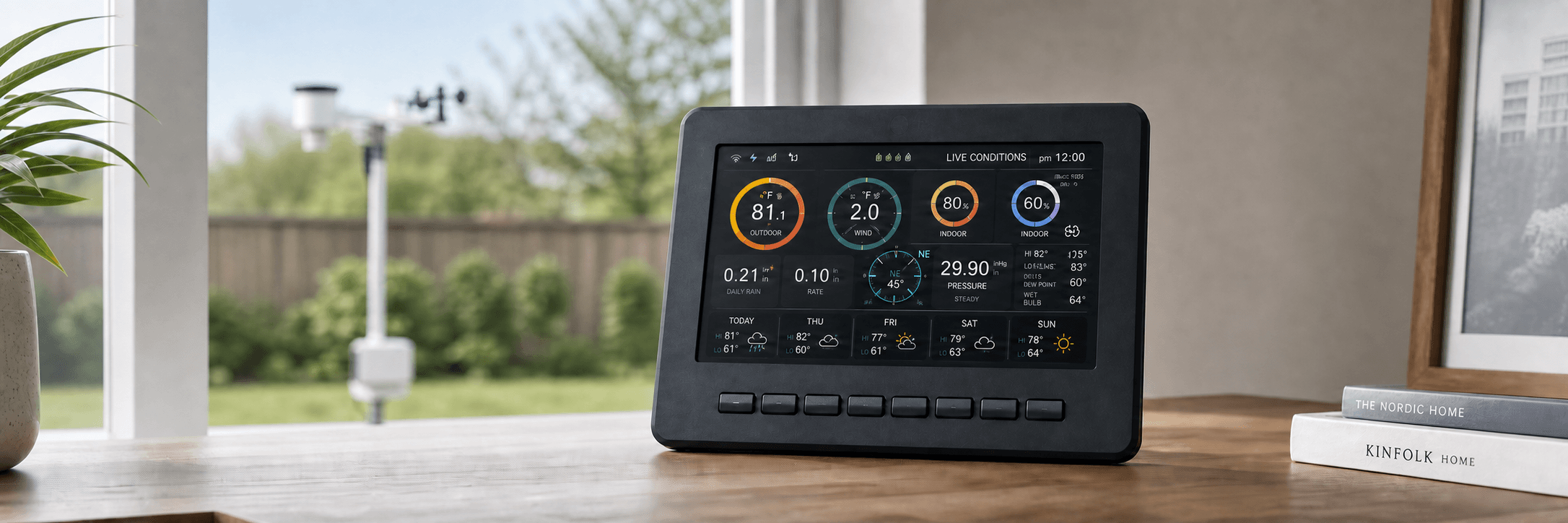
Separate indoor measurement placement
The two packages also treat indoor measurements differently. On the WS-2902, indoor temperature, indoor humidity, and barometric pressure are normally measured at the console. Move the console near a sunny window, television, kitchen appliance, or exterior door and you also move the indoor measurement point.
The WS-2000 includes a separate WH32B thermo-hygrometer-barometer. You can put the display where it is easy to read and place the WH32B where it better represents the indoor area you care about. That separation is valuable when the best screen location is not the best sensor location. It does create one more small device to position and maintain, so a buyer who wants the simplest possible setup may prefer the WS-2902 arrangement.
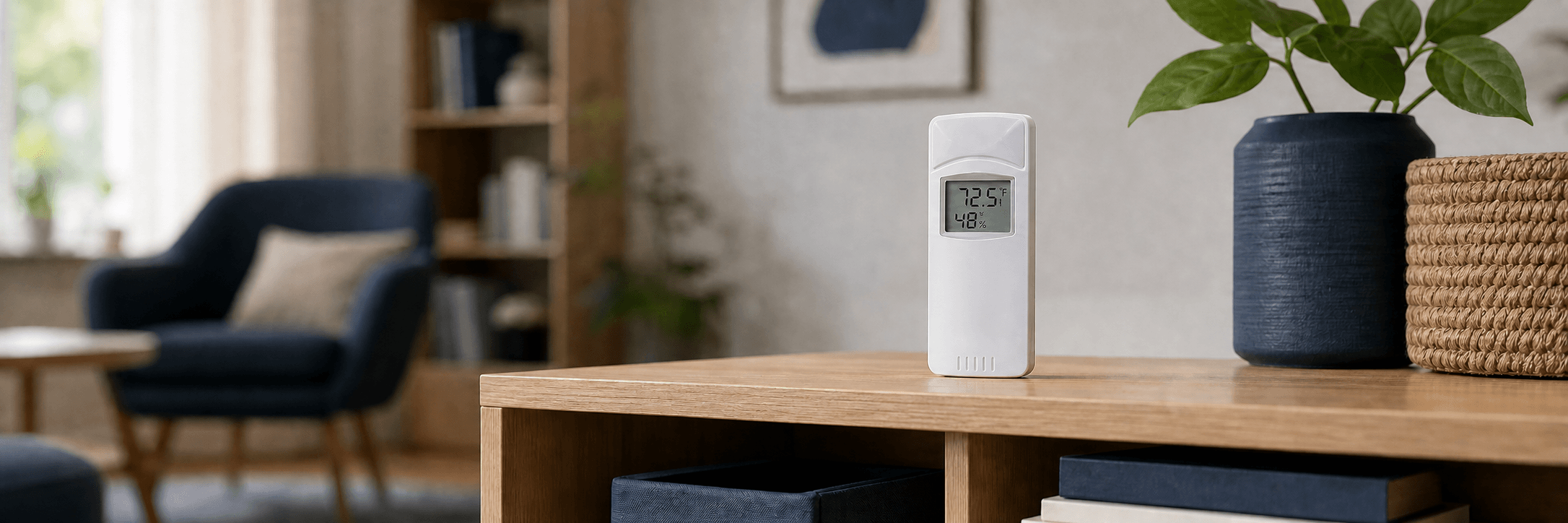
Expansion sensors: the most important long-term difference
The legacy version of this article said the WS-2902 was not expandable. That is too broad for current revisions. Ambient lists optional sensor compatibility for the WS-2902 family, but the supported set is smaller and the experience varies by console revision and firmware. Before buying an add-on, match its exact model number to the compatibility list for your console rather than assuming every 915 MHz Ambient sensor will appear correctly.
The WS-2000 is the stronger expansion platform. Ambient’s current support material lists temperature/humidity sensors, waterproof probes, leak detectors, lightning detection, indoor and outdoor particulate monitors, air-quality monitors, soil-moisture sensors, leaf-wetness sensors, pool thermometers, and other specialized options across the WS-2000 ecosystem. Channel limits vary by sensor type and firmware. “Supports optional sensors” does not mean every type can be added in unlimited quantities.
Common add-ons readers may want to compare:
WH31SM soil-moisture sensor
WH51LW leaf-wetness sensor
WH31LA leak detector
PM25IN particulate sensor
Amazon availability changes. Confirm the exact sensor model, console compatibility, firmware requirement, and channel limit before ordering.
Core weather is enough
You want the included array, console, and online dashboard, with perhaps a modest add-on need later.
You will monitor more places
You expect basement, greenhouse, freezer, pool, soil, air-quality, leak, or lightning observations to become part of the system.
Compatibility is model-specific
Check the exact sensor, console revision, firmware requirement, channel limit, and whether its reading appears on the console, online, or both.
Wi-Fi, apps, and smart-home use
Both stations are designed to put data online without a separate internet bridge. They connect through Wi-Fi and can publish to the Ambient Weather Network, where owners can view current conditions, charts, history, alerts, and shared dashboards. Ambient also documents integrations such as Amazon Alexa, Google Home, IFTTT, and its developer API, although supported commands and services can change.
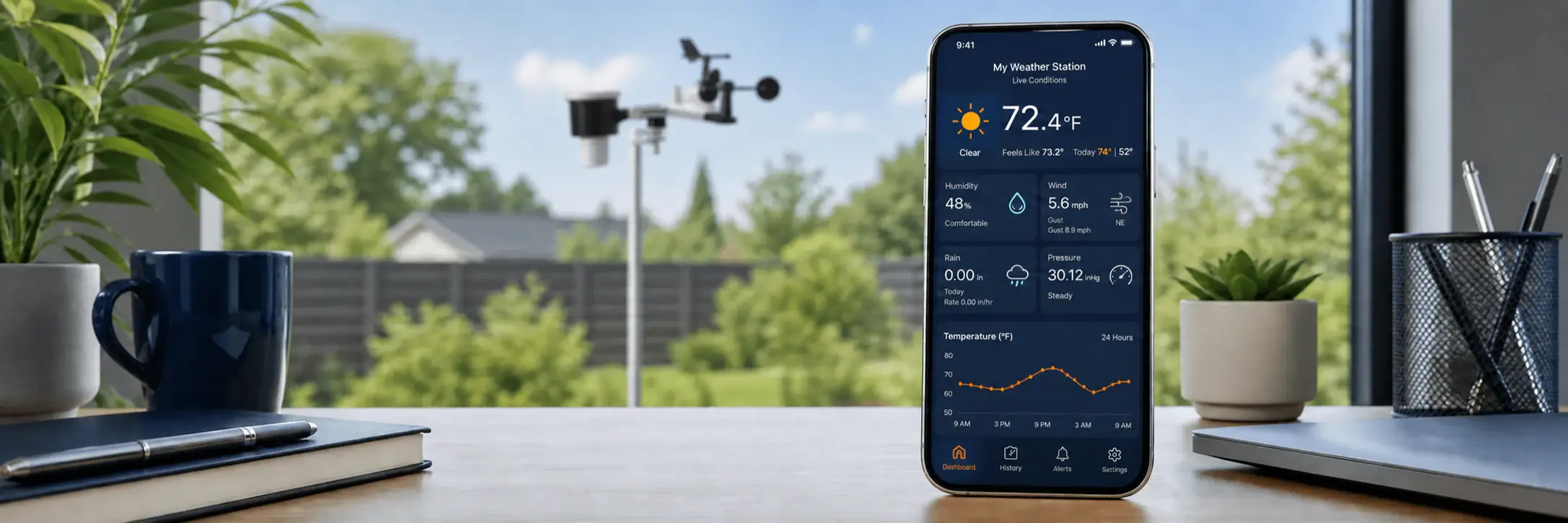
Be careful with setup advice written for an older WS-2902A, B, or C. The current product page points buyers to a WS-2902D manual, and the button sequence or app used during Wi-Fi setup may differ from an older console. Follow the manual packaged with the exact revision in front of you. The WS-2000’s full console menus remain easier to navigate when entering network settings and managing optional sensors.
If getting observations online is your main goal, our guide to uploading weather-station data explains the full chain from a valid measurement to a reliable public feed.
Which one should you buy?
You want the better value
- Your priority is accurate, well-sited backyard weather rather than the premium console.
- You will view most history and detail online.
- You do not expect to build a large network of specialized sensors.
- You prefer fewer separate indoor components.
- The price difference would be better spent on a sound mast or better siting.
You want the better platform
- The local display will be read frequently or from across a room.
- You want indoor sensing independent of the console’s location.
- You plan to add several rooms or specialized environmental sensors.
- You value on-console configuration, calibration, and sensor management.
- You expect this station to grow with your monitoring needs.
Prices, sellers, discounts, and bundle contents change too often to make a fixed dollar comparison useful. Use the current-offer buttons to compare the exact listings. If the gap narrows, the WS-2000 becomes easier to justify. If you do not need its screen or expansion options, the WS-2902 remains the more rational value.
Already own a WS-2902? You may not need a new array
Ambient states that a WS-2000 console can be added to a WS-2902-series station because the systems use the same primary outdoor array. That creates a useful upgrade path: keep a functioning array and check the WS-2000 console-only listing on Amazon instead of replacing the entire outdoor installation.
Before ordering a console by itself, confirm the exact array and console revision, included power adapter, indoor-sensor requirements, radio frequency for your market, and how you plan to handle data uploads. A console-only purchase may not include the WH32B sensor that normally supplies the WS-2000’s indoor temperature, humidity, and pressure readings. Read the listing’s “included items” rather than relying on a product-family photo.
Accuracy, placement, and maintenance still matter more
Neither model can overcome a poor site. Roof heat can bias temperature, nearby walls and trees can distort wind, sprinklers can contaminate rainfall totals, and an unlevel or clogged rain collector can make a believable number wrong. The shared compact array is convenient, but its combined design always requires a compromise between the ideal exposure for temperature, rainfall, and wind.
After installation, document array height, orientation, nearby obstructions, console and sensor locations, units, elevation settings, and the date of any calibration offsets. Validate several days of readings against appropriate nearby observations before changing calibration. Then use the weather station accuracy guide and maintenance checklist when a value looks suspicious.
Frequently asked questions
Is the WS-2000 more accurate than the WS-2902?
Not simply because it costs more. The two packages use the same basic outdoor array, so siting, maintenance, calibration, and exposure dominate the outdoor-reading difference. The WS-2000 mainly upgrades the console, indoor-sensor placement, and expansion capability.
Do the WS-2000 and WS-2902 use the same outdoor sensor array?
Ambient’s current product and support material identifies the same WH65/Osprey-style array architecture for these systems. This is why a WS-2000 console can work with a WS-2902-series array. Always verify regional frequency and the exact revision before mixing components.
What is the difference between WS-2902C and WS-2902D?
The suffix identifies a console/product revision, not an entirely different weather-measurement concept. Current retail material may use the broader WS-2902 name while linking to a WS-2902D manual. Use the manual and compatibility list for the specific console you receive.
Can the WS-2902 use extra sensors?
Some revisions can use selected additional temperature, probe, particulate, and related sensors. The WS-2000 supports a broader range and is the safer choice when expansion is central to the purchase. Verify the exact sensor model, channel limit, and where its data will be displayed.
Can I upgrade a WS-2902 with the WS-2000 display?
Ambient says yes because the stations use the same outdoor array. Confirm that a console-only listing includes—or requires you to add—the correct indoor thermo-hygrometer-barometer and power accessories.
Which is better for a first weather station?
The WS-2902 is usually the value choice for learning and core backyard observations. Choose the WS-2000 instead if you already know that display quality, separate indoor placement, or multiple optional sensors will matter.
Bottom line
Buy the WS-2902 for the weather measurements, buy the WS-2000 for the better way to view, place, and expand them. Because the outdoor array is essentially the same, the WS-2902 is not a lesser station where basic backyard weather is concerned. The WS-2000 earns its premium through a far better console, a separate indoor sensor, easier local management, and a wider expansion path.
For deeper product-specific coverage, continue to the Ambient Weather WS-2000 review or the Ambient Weather WS-2902 review. You can also browse the full WXObservation weather-station guide library.
Manufacturer sources
- Ambient Weather WS-2000 product page and manual links
- Ambient Weather WS-2902 product page and manual links
- Ambient Weather’s official WS-2000 and WS-2902 comparison FAQ
- Ambient Weather’s WS-2000 compatible-sensor reference
Related Station Guides
Use these practical guides to get more reliable readings and a better ownership experience:
- All-in-one station tradeoffs — Learn where integrated arrays simplify setup and where shared placement creates compromises.
- Weather station sensors explained — Understand what each sensor measures and how its design affects the data.
- Share station data online — See why owners publish observations and what to consider before connecting a network.