
Weather records explained
What Does “Trace” Precipitation Mean?
A trace means precipitation occurred but the amount was below the smallest reportable measurement. It is not zero—and it is not a tiny number to add to totals.
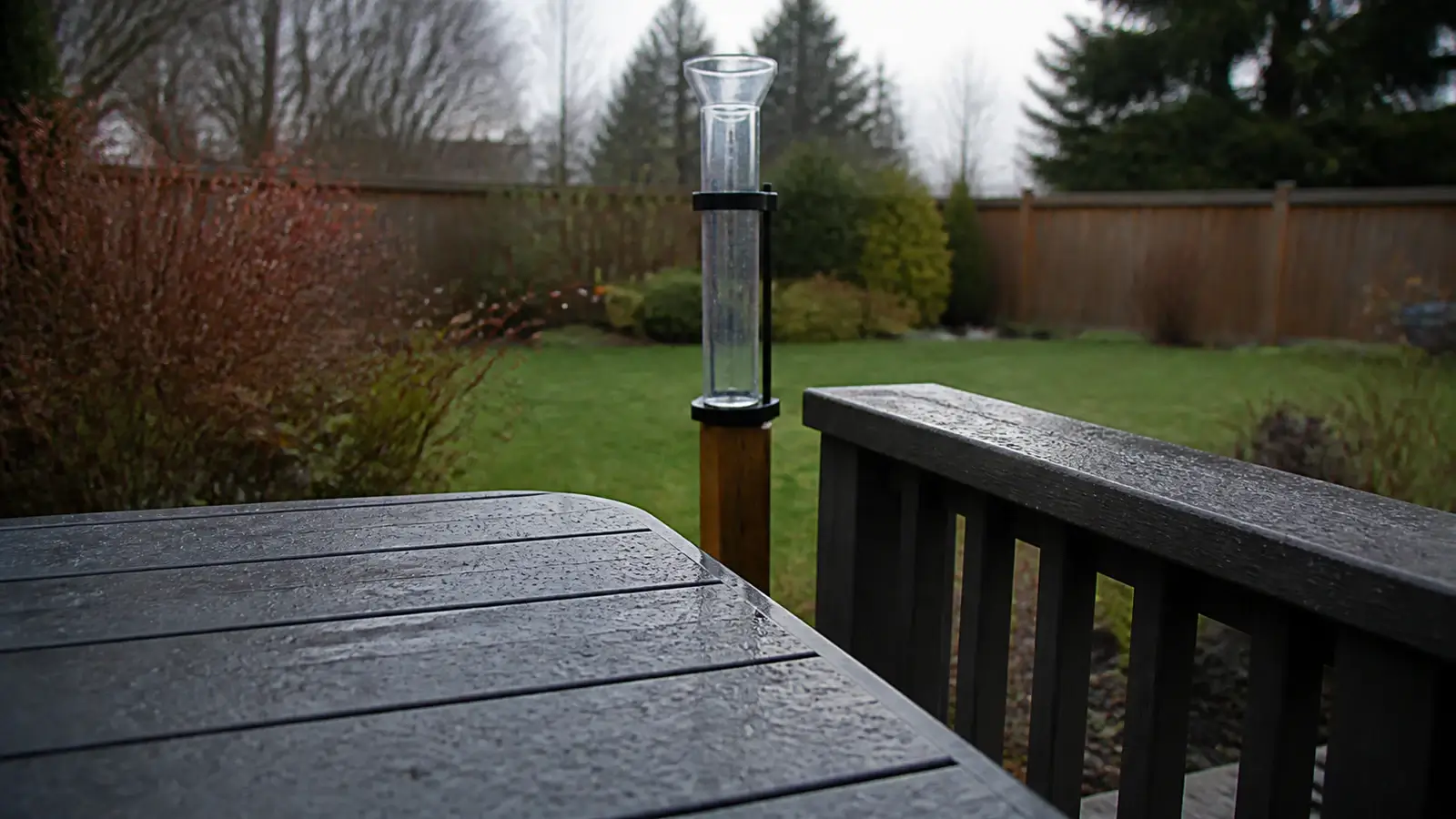
Quick answer
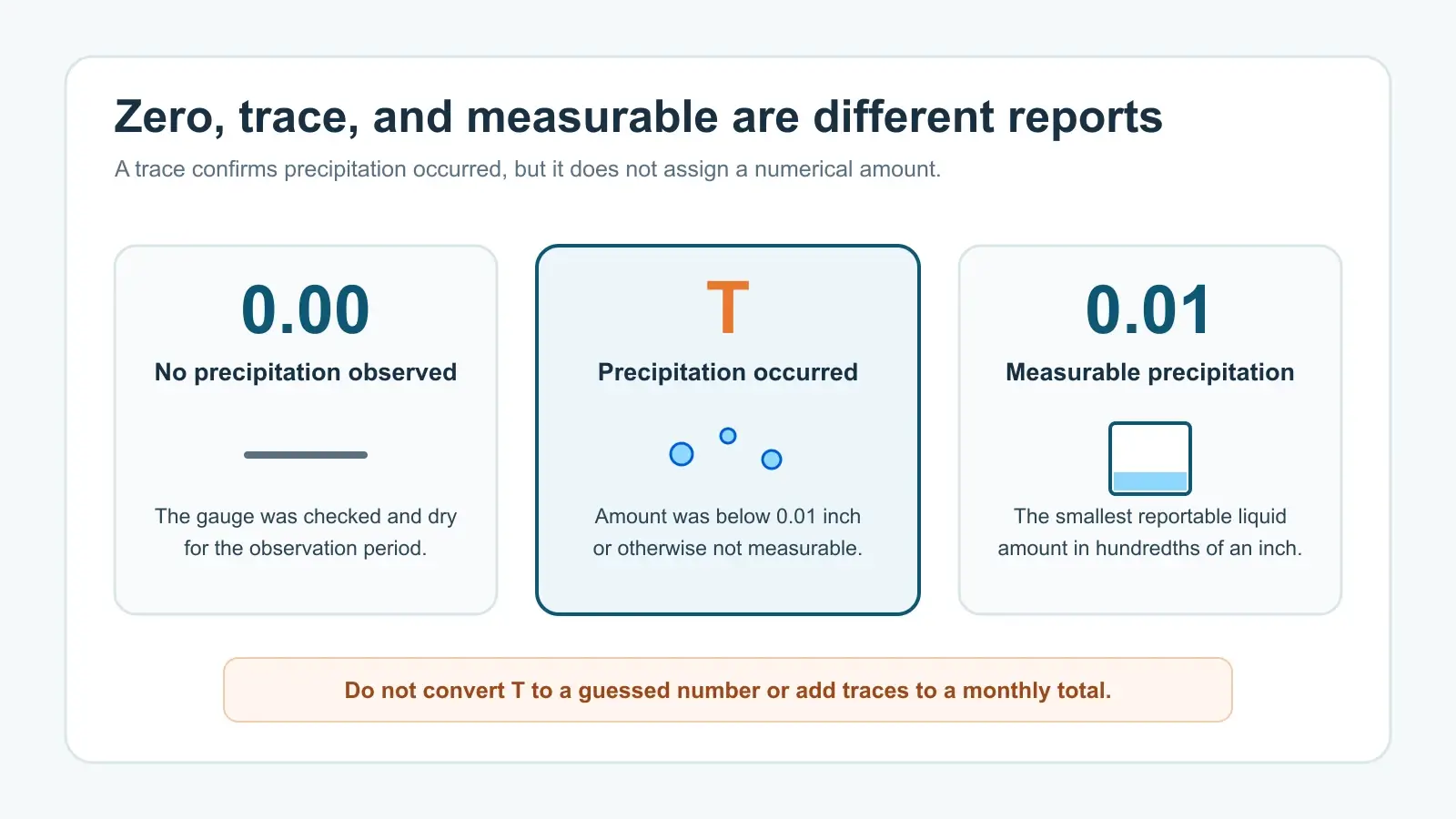
Trace precipitation is an observed amount too small to measure at the reporting precision. For liquid precipitation reported to the nearest 0.01 inch, a trace is more than none but less than 0.01 inch. Weather records usually show it as T. A trace has no fixed numerical value, so it should not be entered as 0.005 or added to a monthly total.
Open a daily climate table and you may see a letter T beside precipitation or snowfall. That single character carries useful information: something fell from the atmosphere, an observer or instrument detected it, and the amount did not reach the smallest measurable increment for that field. It prevents a very light event from disappearing into a row of zeros.
The idea is simple, but trace reports are often misunderstood. Some readers treat T as another way to write zero. Others convert it into a guessed decimal. Both erase the distinction the notation was designed to preserve.
What “trace” means in a weather observation
For the common U.S. liquid-precipitation scale, observers report rain and melted precipitation to the nearest hundredth of an inch. If rain, drizzle, snow, sleet, or another hydrometeor definitely occurred but produced less than 0.01 inch of liquid, the report is T rather than 0.00. The National Weather Service uses the same convention in its daily and monthly climate forms.
A trace describes a relationship to measurement precision, not one universal volume. It could represent a few drops that barely wet the collector or an amount just below the reporting threshold. The observer knows precipitation occurred but cannot assign a defensible hundredth-inch value. T communicates that uncertainty honestly.
Trace is an observation, not a guess. A damp gauge alone is not enough when dew, fog, irrigation, splash, or handling could explain the moisture. Record T only when you know precipitation fell during the observation period.
How T differs from 0.00 and missing data
| Report | Meaning | What you can conclude |
|---|---|---|
| 0.00 | The gauge was checked and no precipitation was observed | The observation period was dry at that site |
| T | Precipitation occurred, but the amount was below measurable or reportable precision | The period was not completely precipitation-free |
| 0.01 in | A measurable hundredth of an inch was collected | At least the minimum reportable liquid amount fell |
| M or blank | The observation is missing or unavailable | You cannot conclude that the period was dry |
Missing is especially important. A blank cell does not mean 0.00, and replacing it with zero creates a false dry day. Likewise, T does not mean the observer forgot to measure. It is a valid reported outcome. Good datasets preserve all four states rather than forcing every entry into a decimal column.
Trace rain, snow, sleet, and freezing precipitation
Trace can appear beside more than rainfall. A brief shower may leave drops but less than 0.01 inch in a gauge. Flurries can be visible in the air without producing a measurable tenth of an inch of new snowfall. A few ice pellets or a very light glaze may also be reported as a trace when the applicable accumulation threshold is not reached.
The threshold depends on the element being reported. Liquid precipitation is commonly measured to 0.01 inch. New snowfall is commonly measured to 0.1 inch, so snow can be a trace when flakes occurred but accumulation was below one tenth. Snow depth uses a different precision again. A trace of snowfall requires at least a trace of liquid equivalent. Measurable liquid can also accompany trace snowfall when wet snow mixes with rain.
A trace does not describe intensity. Light drizzle lasting hours and a ten-second sprinkle might both end as T, while a short heavy shower could produce a measurable total. Intensity describes the rate at a moment. Accumulation describes what collected over the full reporting period.
How a home observer should record a trace
- Confirm that precipitation occurred. Use direct observation, a clean gauge, and the weather around the site. Exclude dew, sprinkler water, and condensation.
- Apply the correct measurement method. Read liquid at eye level from the bottom of the meniscus. Measure new snow on a prepared surface rather than inferring it from wet pavement.
- Use T when the amount is below the smallest reportable unit. Do not write 0.00, because that falsely says none occurred.
- Add a brief note when helpful. “Brief sprinkle at 3:20 p.m.” or “Flurries, no accumulation” makes a personal log easier to interpret.
If you participate in CoCoRaHS or another observer program, follow its entry form and instructions. CoCoRaHS accepts T for liquid precipitation below 0.01 inch and 0.00 when nothing fell. Our guide to measuring rainfall accurately covers gauge placement and reading in detail.
Why you should not add traces to a total
Because T has no exact numeric value, traces cannot be summed mathematically. Ten trace days do not necessarily equal 0.05 inch, 0.10 inch, or any other amount. Each day could have contained a different quantity below the threshold. Climate summaries therefore keep T as a notation while adding only measurable amounts to the monthly or annual precipitation total.
This produces an outcome that can look odd: a month may list several days with precipitation but a total of 0.00 inch. That does not mean the table contradicts itself. It means precipitation was observed on those days, yet no event reached a measurable hundredth. The count of precipitation days and the accumulated depth answer different questions.
For analysis software, preserve trace as its own category or flag. If a calculation absolutely requires a number, the chosen substitution is a modeling assumption, not the recorded observation. Document it, test how it affects the result, and keep the untouched source data. Never silently turn T into zero or half the detection limit.
How to read T in forecasts and climate tables
Trace notation appears most often in observed climate records, not as a promise in an ordinary public forecast. A National Weather Service daily climate report may show T in the precipitation, snowfall, or snow-depth column. Read the column heading and footnotes because each uses its own units and definitions. On the NWS CF6 climate form, T is explicitly the symbol for a trace.
A forecast phrase such as “a trace of snow is possible” uses the word more informally to communicate little or no measurable accumulation. It still suggests flakes may occur, but it is not a completed official measurement. The observation can only be assigned after the period is examined.
Radar color over your location does not by itself justify a trace report. Radar samples the atmosphere aloft, and precipitation may evaporate before reaching the surface. If the map looked wet but your site stayed dry, see why radar can show rain that never reaches the ground.
Use this quick decision
- Nothing fell and the observation is valid: record 0.00.
- Precipitation definitely fell but was below the measurement threshold: record T.
- The minimum increment was reached: record the measured number.
- You could not make a trustworthy observation: mark it missing and explain why.
Frequently asked questions
How much rain is a trace?
More than none but less than 0.01 inch when liquid precipitation is reported to hundredths. It has no single exact value.
Does trace precipitation count as a rainy day?
It can count as a day on which precipitation occurred, depending on the dataset’s definition. It does not add a measurable amount to the precipitation total.
Can I convert T to 0.005 inch?
Not as an observation. That value may be used as a documented statistical assumption in a particular analysis, but the original report remains T because the exact amount was unknown.
Is dew a trace of precipitation?
The answer is no. Dew forms when water vapor condenses on a surface. It did not fall from a cloud. Fog deposition and sprinkler water also should not be reported as trace precipitation.
Sources and further reading
- CoCoRaHS: Measuring rain and reporting traces
- National Weather Service Tallahassee: CF6 climate form help
- National Weather Service: Cooperative observer precipitation guidance (PDF)
- National Weather Service Des Moines: Precipitation measurement refresher
Reviewed against current National Weather Service, NOAA, and volunteer-observer guidance on August 7, 2026.