
Severe-weather observation guide
How to Measure and Report Hail Size
Measure the largest stone only when it is safe, report diameter—not circumference—and give the National Weather Service the location, time, method, and damage.
Quick answer
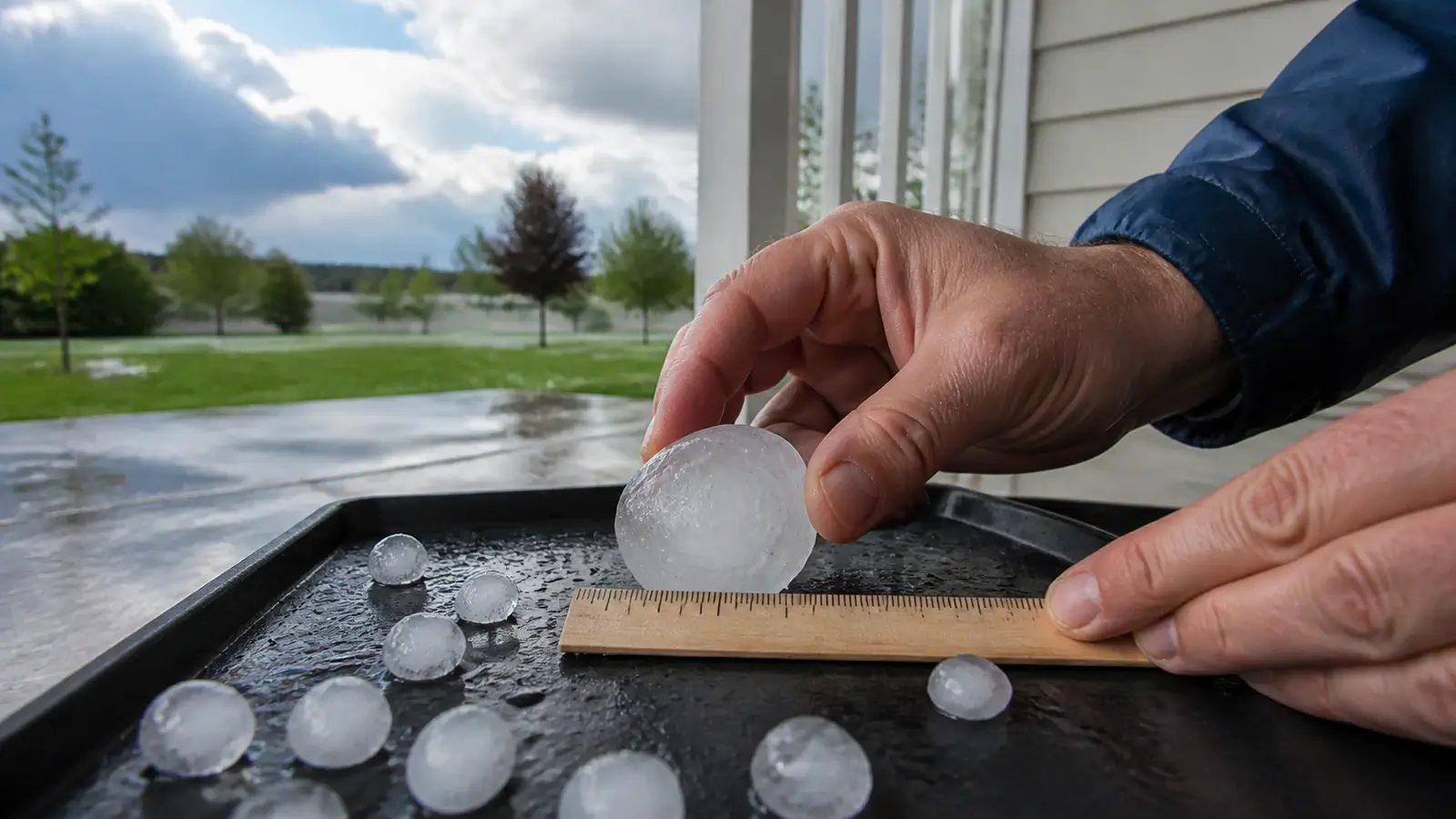
Stay indoors while hail and lightning are occurring. When the immediate threat has passed, use a ruler or caliper to measure the largest stone across its widest point. Report diameter in inches, whether it was measured or estimated, the exact location and time, and any damage. In the United States, hail one inch in diameter—about quarter size—or larger meets the National Weather Service severe-thunderstorm criterion.
Hail reports help meteorologists understand what a storm is producing between radar sites and warn communities downstream. “It hailed here” is useful, but “largest stone measured 1.25 inches at 4:18 p.m. two miles north of town” is much more actionable. The difference comes from a safe measurement and a few precise details.
You do not need special credentials to report dangerous weather. Trained spotters learn the same core principle covered here: describe what you can verify, separate measurement from estimation, and never place yourself in danger to improve a report.
Do not collect hail during the storm
Large hail can cause serious injury, and a hail-producing thunderstorm also carries a lightning threat. Observe from a substantial building or an enclosed hard-top vehicle with the windows closed. Do not run into a yard, step under a porch roof, or stand in an open garage to retrieve stones. Windows can break, so move away from exposed glass when hail becomes large or wind-driven.
Wait until the immediate hail and lightning threat has passed before going outside. If you can still hear thunder, you remain within striking distance. Follow the 30-minute lightning rule. A report made from safety, even if the hail has partly melted, is more valuable than a dangerous attempt at a perfect measurement.
Report an ongoing emergency immediately. If hail has injured someone, broken windows into occupied rooms, or created another life-threatening hazard, call 911. Weather-report channels do not replace emergency services.
How to measure a hailstone correctly
- Choose the largest representative stone. The National Weather Service wants the maximum size observed, not an average of all stones. If several large stones are available, check more than one.
- Measure before melting changes it. Work quickly once it is safe. Place a stone in a sealed bag in a freezer if you need to preserve it, but write down the original time and location.
- Measure the widest diameter. Put a ruler across the widest straight-line distance from one edge to the opposite edge. Do not measure around the stone. Circumference produces a much larger number.
- Record to a sensible precision. A ruler may support a quarter-inch or eighth-inch estimate. A caliper can be more precise. Avoid decimals your tool cannot justify.
- Photograph the measurement. Place the ruler in the same plane as the stone, include the zero mark and units, and take the image straight on to limit perspective distortion.
Hail is often irregular rather than perfectly round. Measure the longest diameter and say “widest dimension” if that makes the method clearer. If two stones froze together, note that it was an aggregate rather than treating it as one ordinary sphere. A photo beside a ruler is stronger evidence than a photo beside a hand, because hands vary and perspective can exaggerate foreground objects.
Official hail size comparisons
When you cannot measure safely, the National Weather Service accepts familiar size comparisons. Coins and standard sports balls work because their dimensions are reasonably consistent. Avoid “marble size”: marbles come in many diameters and the phrase can mean different things to different people.
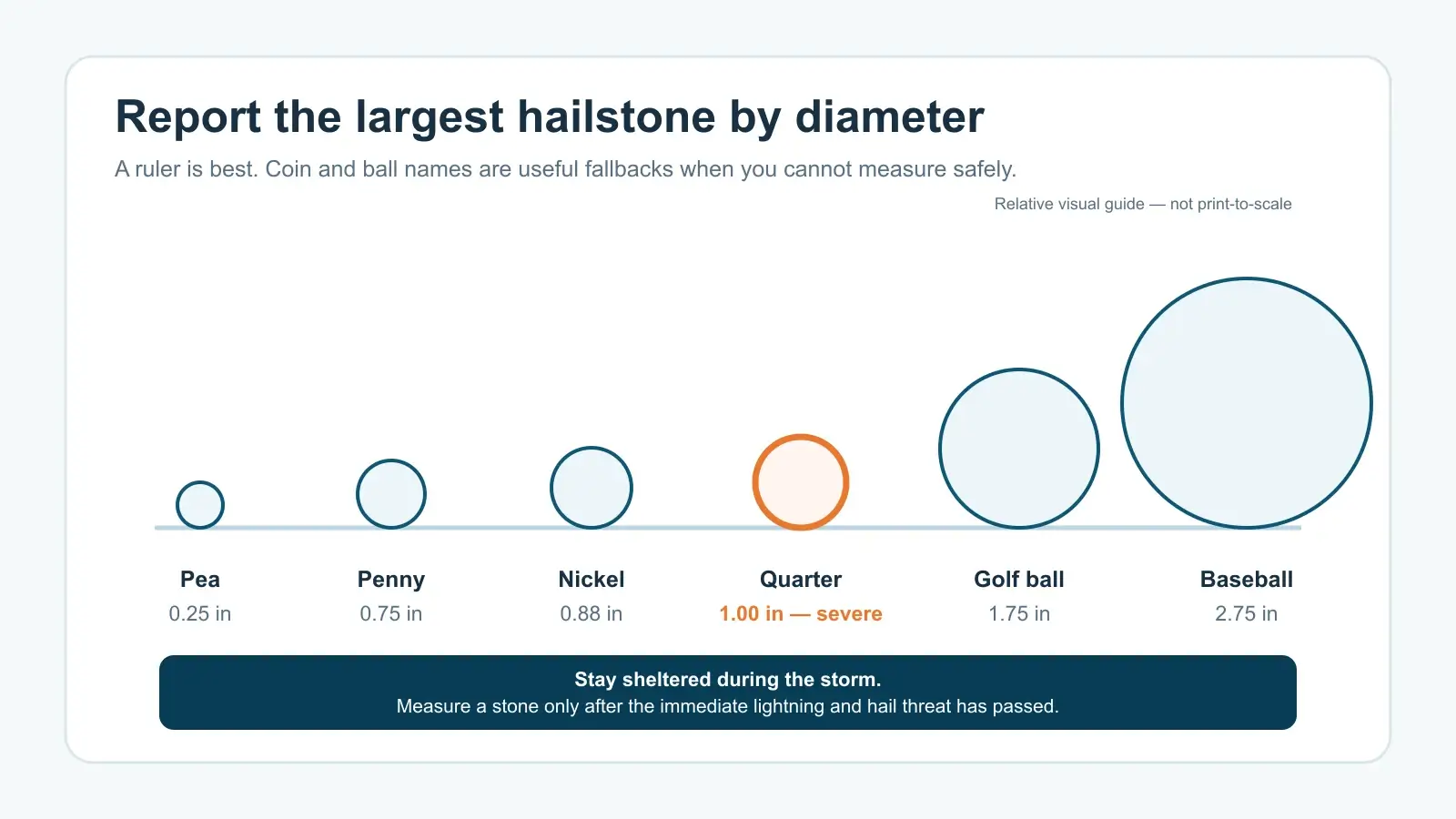
| Description | Diameter | Reporting note |
|---|---|---|
| Pea | 0.25 in | Small hail, still note duration and whether it covered the ground |
| Dime | 0.70 in | National Weather Service field-guide comparison |
| Penny | 0.75 in | Commonly reported sub-severe size |
| Nickel | 0.88 in | Just below the U.S. severe threshold |
| Quarter | 1.00 in | Meets the NWS severe hail criterion |
| Half dollar | 1.25 in | May damage vehicles, roofs, and crops |
| Ping-pong ball | 1.50 in | Use ping-pong, not an unspecified “ball” |
| Golf ball | 1.75 in | Dangerous large hail |
| Hen egg | 2.00 in | A recognized comparison in NWS guides |
| Tennis ball | 2.50 in | Destructive hail, stay well protected |
| Baseball | 2.75 in | Extremely dangerous hail |
| Softball | 4.50 in | Rare, life-threatening giant hail |
The one-inch threshold is a warning criterion, not a line between harmless and harmful. Smaller stones driven by strong wind can still injure people and damage plants, while the vulnerability of roofs and vehicles varies. Report credible sub-severe hail too when your local Weather Forecast Office requests it, especially if it accumulates deeply or produces damage.
What to include in a useful hail report
A meteorologist needs to locate the observation in space and time and understand its reliability. Lead with the largest size, then give the essentials in a compact sentence:
Hail report checklist
- What: largest hail diameter and whether measured or estimated.
- When: the time hail began, peaked, or was measured, with time zone if needed.
- Where: street intersection, town and state, or distance and direction from a known place.
- Duration: approximately how long hail fell and whether it is still occurring.
- Damage: broken windows, dented vehicles, roof or siding damage, stripped vegetation, or none observed.
- Source: your direct observation rather than a relayed social-media image.
Example: “At 4:18 p.m. CDT, 1.25-inch hail measured with a ruler at Oak Street and Highway 6 in Smithville. Hail lasted about six minutes, vehicles are dented and no injuries are known.” If you estimated the size from inside, say so: “Quarter-size hail estimated through a window.”
Use the reporting channels published by your local National Weather Service office. Depending on the office, these may include a phone number, an online form, amateur radio, or a designated social account. Trained SKYWARN spotters should follow the instructions provided during their course. Our guide to becoming a trained weather spotter explains how the program works.
How to document hail damage without overstating it
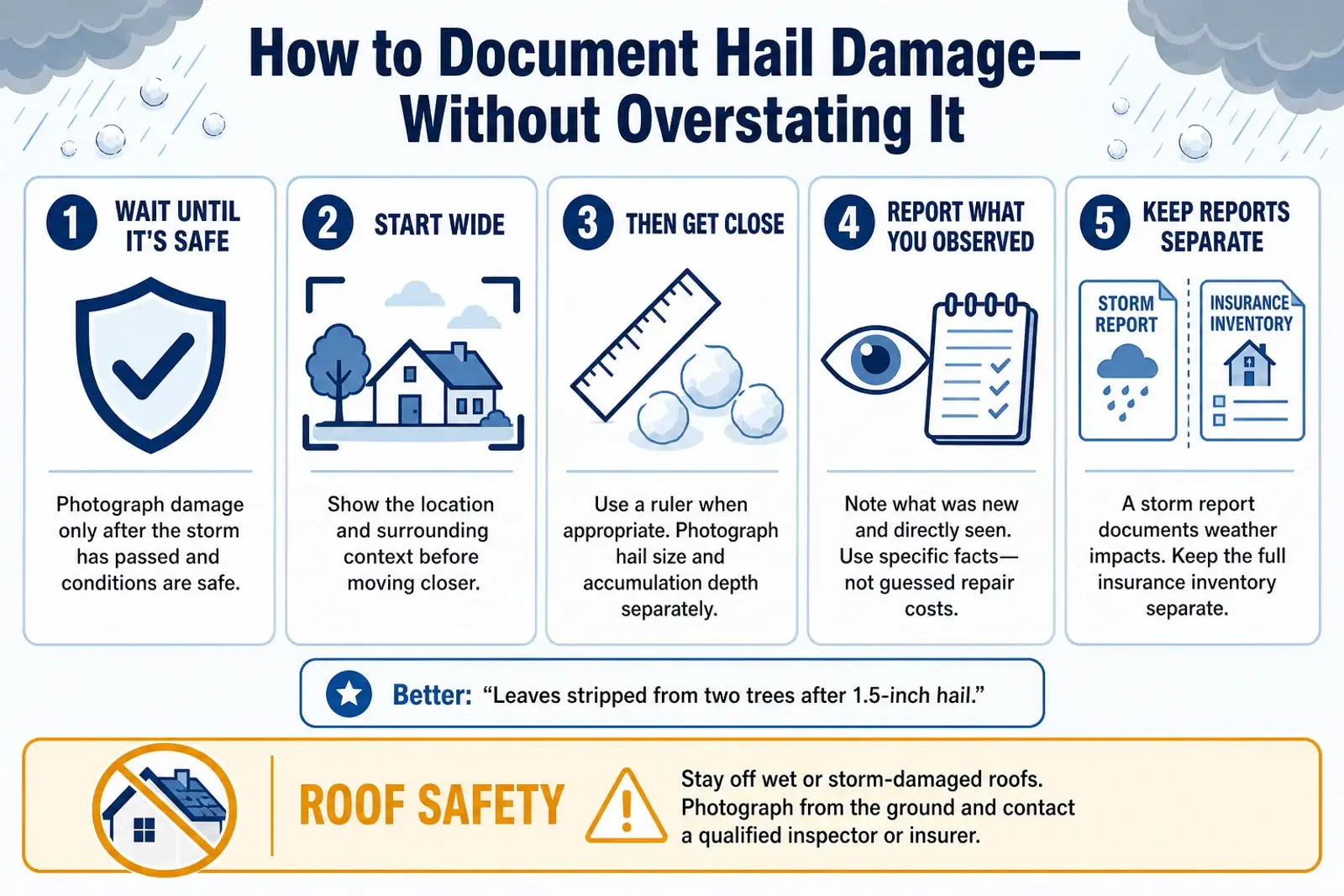
Photograph damage after conditions are safe. Start with a wider image that shows location and context, then take a closer image with a ruler where appropriate. Note whether the damage was new and directly observed. “Leaves stripped from two trees immediately after 1.5-inch hail” is more defensible than guessing the dollar value of landscape loss.
For roofs, do not climb during or just after a storm. Wet surfaces, hidden damage, and continuing lightning make that unsafe. Photograph visible impacts from the ground and contact a qualified inspector or insurer if needed. Keep insurance documentation separate from the concise storm report. The NWS mainly needs the weather impact, not a complete claim inventory.
If hailstones have piled up, measure the accumulation depth separately from individual stone size. “Three inches of pea-size hail covered the road” communicates two distinct facts. Accumulated hail can make roads slick and clog drainage even when the stones never reached severe diameter.
Common hail-reporting mistakes
- Reporting an average: severe-weather reports focus on the largest credible stone.
- Giving circumference: standard hail sizes are diameters across the stone.
- Using ambiguous comparisons: marbles, grapes, and “handfuls” vary too much.
- Leaving out measured versus estimated: both can help, but they do not carry the same precision.
- Posting without a location or time: a dramatic photo cannot be matched reliably to the storm.
- Going outdoors too early: no report is worth exposure to hail or lightning.
Radar can indicate a strong hail-producing core, but it does not measure the stone that landed at your address. Ground truth is exactly why reports matter. Conversely, do not inflate an estimate because an app labels the storm severe. Measure what fell where you are.
Frequently asked questions
What size hail is considered severe?
In the United States, the National Weather Service severe-thunderstorm criterion is hail at least one inch in diameter, approximately quarter size. Other countries and organizations may use different criteria.
Should I measure the largest hailstone or the average?
Report the largest credible stone observed. You can add that most stones were smaller, but the maximum size is the key operational detail.
Can I report hail if I am not a trained spotter?
The answer is yes. National Weather Service offices accept credible public reports, although the available channels and requested thresholds vary. State exactly what you observed and how you measured it.
How can I keep a hailstone from melting?
Once conditions are safe, place it in a sealed bag and freeze it. Measure and photograph it promptly first, because some melting may already have changed its original size.
Sources and further reading
- National Weather Service Spotter Guide: What and how to report
- National Weather Service Flagstaff: SKYWARN hail size references
- National Weather Service Birmingham: Severe weather reporting guidance
- National Weather Service: Thunderstorm, lightning, and hail safety
Reviewed against current National Weather Service, NOAA, and volunteer-observer guidance on August 7, 2026.