
How Does a Tipping-Bucket Rain Gauge Work?
Most traditional home weather stations measure rain with a small seesaw hidden below the collector funnel. Each tip represents a known rainfall depth, allowing electronics to count accumulation and estimate intensity.
Rain enters a known collector area and drains into one side of a two-cup or tipping-spoon mechanism. When that side holds a calibrated volume, gravity tips it, empties the water, and positions the other side under the funnel. A magnet and reed switch or another sensor records the movement. The station counts tips for accumulation and uses tip timing to estimate rain rate.
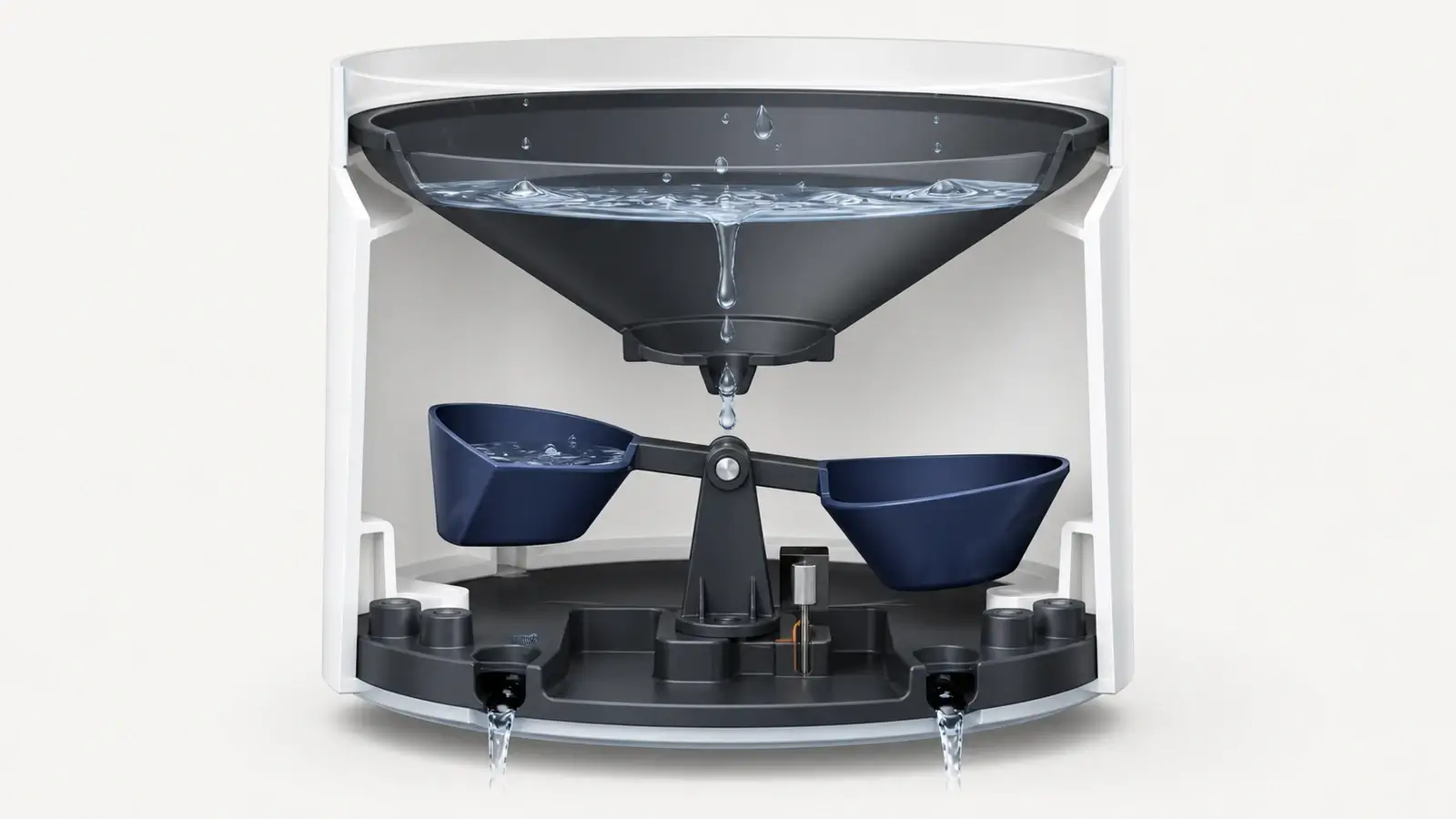
The parts inside the gauge
The opening samples rain falling over a known area. Its geometry connects a captured water volume to a rainfall depth.
The funnel concentrates water onto the mechanism. A screen reduces debris but also needs cleaning.
The balanced mechanism alternates between two receiving positions. Stops and geometry determine the volume needed to tip.
A magnet and sealed reed switch are common. Optical or other sensors can also count each movement.
Electronics convert tip pulses into accumulation and send or store the result.
Gravity must act symmetrically, and emptied water must leave without backing up or splashing into the opposite cup.
One rainfall increment, step by step
Rain crosses the collector opening
The gauge samples only the water that reaches its rim. Wind, splash, overhangs, and blockage can change this catch before the mechanism is involved.
The funnel directs water to one cup
The active cup fills while the opposite cup remains raised. Very light rain may take many minutes to reach the tip volume.
The balance passes its tipping point
Gravity moves the filled side downward. It empties and brings the second cup into position.
The switch records a pulse
A magnet passing a reed switch commonly closes a circuit. The electronics register one calibrated rainfall increment.
The cycle repeats
Total rainfall is the count multiplied by the depth per tip. The time between tips supports a rain-rate estimate.
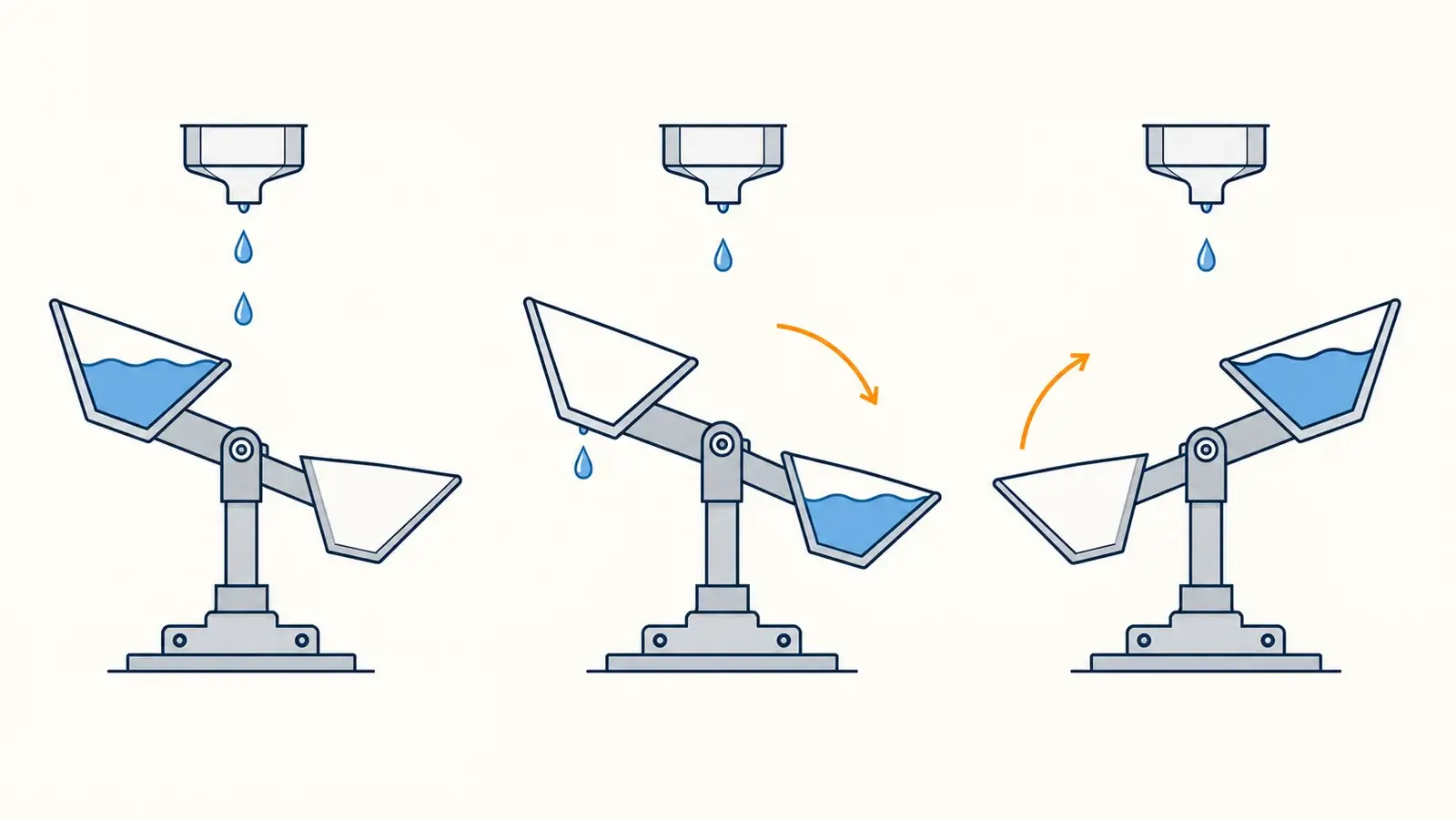
How tips become rainfall depth and rate
The important calibration is not merely the cup volume. It is the captured volume divided by the collector area. A larger opening collects more water for the same rainfall depth. Home gauges commonly represent small discrete increments, but the exact value may be 0.01 inch, 0.2 millimeter, 0.254 millimeter, or another documented amount.
Campbell Scientific’s TE525 specifications illustrate the relationship. Its TE525 and TE525MM use the same 4.73 mL tip volume, but their different collector diameters make one tip equal 0.01 inch on the TE525 and 0.1 mm on the TE525MM.
If one tip represents 0.01 inch, 25 tips add 0.25 inch to the accumulation. Rain rate is different from accumulated rainfall. The station estimates intensity from how quickly tips arrive or from tips within a recent time window. A rapid sequence creates a high rate. A long gap creates a low rate or zero. Because tips are discrete, rate can appear jumpy in light rain.
Where tipping buckets lose accuracy
| Condition | Why it matters | Typical direction of error |
|---|---|---|
| Gauge not level | One side tips at a different effective volume. | Bias can vary by design and tilt direction. |
| Heavy rain | Water continues flowing during the finite tipping movement. | Often undercatch unless corrected by calibration/firmware. |
| Wind | Drops curve around the rim or splash away. | Usually low catch, especially in exposed sites. |
| Debris or insects | Flow is blocked or the mechanism cannot move freely. | Low, delayed, or zero totals, occasional false tips during cleaning. |
| Very light rain | Water may not reach the first tip or may evaporate between drops. | Delayed or uncounted trace precipitation. |
| Snow and ice | An unheated funnel blocks or records melt later. | Missing, delayed, or mis-timed liquid-equivalent data. |
| Vibration | A loose mount can move the mechanism without rain. | This creates false accumulation. |
What the mechanism needs from the owner
- Keep the collector opening, screen, funnel, buckets, and drain path clean using the current manual.
- Recheck level after storms, frost heave, mast work, or any mount movement.
- Keep the gauge stable and away from roof splash, sprinklers, and concentrated runoff.
- Inspect for shipping restraints before first use and for webs or nests during service.
- Use a controlled manufacturer procedure before changing calibration screws or software multipliers.
- Compare several storms with a suitable manual gauge in comparable exposure rather than judging one localized shower.
Newer home stations may use haptic or piezoelectric rain detection instead of a bucket. Those sensors estimate rainfall from impacts and have different siting, vibration, calibration, and maintenance behavior. “No moving parts” does not mean no limitations.
Frequently asked questions
How much rain does one bucket tip equal?
It depends on the gauge. Common examples include 0.01 inch (0.254 mm), 0.2 mm, and 0.1 mm per tip. Use the exact model specification rather than assuming.
Can a tipping-bucket gauge measure rain rate?
The answer is yes. The station estimates rate from tip frequency or a recent tip window. The displayed rate is less smooth in very light rain and can be biased in extreme intensity.
Why does a tipping bucket undercount heavy rain?
The mechanism takes a finite time to move. Water can pass while neither cup is in its ideal receiving position, and wind or splash can add further undercatch.
Will a tipping bucket measure snow?
An ordinary unheated gauge often blocks with snow and may record water later during melting. Follow the product’s precipitation and heater limitations.
Sources and further reading
These official operational and manufacturer references support the mechanism, model differences, care steps, and measurement limits in this guide.
Campbell Scientific: TE525 tipping-bucket overview — calibrated tipping action, magnet, switch closure, and pulse counting
Campbell Scientific: TE525 specifications — collector diameters, tip volumes, rainfall increments, and rated accuracy
Campbell Scientific: TE525 troubleshooting and maintenance — pulse settings, switch checks, and debris removal
Met Office: how rainfall is measured — automatic tipping-bucket measurement, 0.2 mm increments, and frozen-precipitation cautions
Oklahoma Mesonet instruments — operational tip counting plus light-rain, heavy-rain, wind, and frozen-precipitation limits
Model controls and reset sequences vary. Use the current manual for your exact console, sensor, hardware revision, and radio region before changing calibration, power, pairing, or network settings.