
Vehicle hail protection guide
Hail Protector Review: What It Does, Limits, and Better Alternatives
The inflatable Hail Protector offers full-vehicle impact spacing and multiple power options, but cost, storage, practice, fit, and deployment time determine whether it is practical for your situation.

Our verdict
Skip it when: storage space is tight, warnings often reach you too late, or you cannot safely deploy and secure it before storms.
Most important buying step: measure the vehicle's overall length and select the manufacturer's matching car, SUV, or truck system.
How the inflatable cover works
The blower fills chambers that hold a fabric surface away from the vehicle. A hailstone first contacts the inflated shell, and the space between that shell and the sheet metal helps absorb and spread the impact. Full inflation also covers glass and vertical panels that a roof-only pad does not protect.Unlike a rigid shelter, the system depends on electricity, tiedowns, fit, and advance notice. It is not something to deploy after hail has started. The National Weather Service thunderstorm safety guidance takes priority: move indoors and stay away from windows. Never go outside to save a vehicle during a severe storm.Setup, power, storage, and fit
- Measure before ordering. Use bumper-to-bumper length, then confirm whether the vehicle belongs in the car, SUV, or truck range.
- Complete the first assembly in fair weather. Route the blower and tie points before a warning day.
- Practice a full deployment. Time it, test each power option, and confirm the inflated shell clears mirrors and body panels.
- Inspect before the season. Check fabric, cinches, batteries, adapters, and the blower.
- Deploy before the storm reaches you. If thunder is audible or hail is already falling, stay inside.
Run a deployment drill before storm season
An inflatable hail cover is emergency equipment, not a conventional dust cover. Its value depends on whether the owner can move from a stored bundle to a fully inflated, correctly secured system while the weather is still safe. Do the first drill on a dry, calm day. Lay out every component, identify the front and rear of the cover, find each cinch and blower connection, and follow the current manufacturer instructions for the exact system. Do not improvise anchor points or assume the arrangement for a previous vehicle is still correct.Time the complete process rather than just inflation. Include carrying the bag to the vehicle, unfolding without dragging it across dirty pavement, positioning it over mirrors and trim, connecting the blower, securing the prescribed points, and confirming the shell does not rest against vulnerable panels. Then repeat the drill with the power source you expect to use during an outage. A working wall adapter is not a complete plan if a thunderstorm has already interrupted utility power.| Drill check | What success looks like | Reason to stop and correct it |
|---|---|---|
| Fit | Cover is centered and the inflated shell clears the vehicle as designed | Wrong size, binding around mirrors, or exposed areas |
| Power | Blower runs from the intended primary and backup sources | Weak batteries, damaged leads, or untested adapters |
| Securing | Every prescribed strap and cinch is routed and tensioned correctly | Twisted webbing, worn hardware, or improvised weights |
| Timing | Setup finishes comfortably before the owner's safety cutoff | A plan that requires working outside as the storm arrives |
Current hail-cover alternatives
As an Amazon Associate, WXObservation earns from qualifying purchases. The product links and images below lead to Amazon, confirm availability, seller, exact size, and included components before ordering.
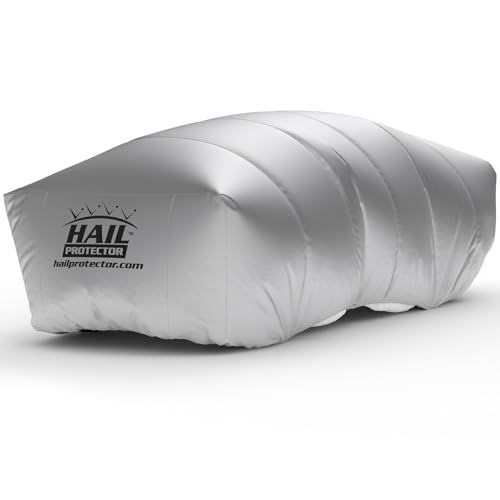
Hail Protector CAR2
Check before buying: measure bumper-to-bumper length and use the manufacturer's current car, SUV, or truck size chart.
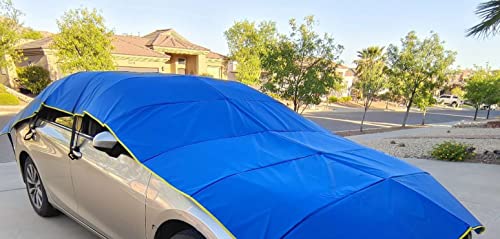
HailOut Rapid Ready
Check before buying: confirm the listed vehicle-size range and remember that the doors and other side panels remain exposed.

Kayme EVA cover
Check before buying: match the cover's stated length range to the vehicle and treat the padding as mitigation, not shelter.
Which type should you choose?
| Type | Best use | Main limitation |
|---|---|---|
| Permanent shelter | Daily protection with no warning-time setup | Space, permits, engineering, and cost |
| Inflatable system | Portable full-vehicle protection | Setup, power, storage, and higher price |
| Rapid roof shield | Fast protection for roof and glass | Exposed side panels |
| Padded full cover | Lower-cost mitigation for a measured fit | Finite padding and wind management |