
Ambient Weather WS-5000 Review: Is the Premium Worth It?
The WS-5000 earns its premium through a fast ultrasonic wind sensor, a separate serviceable rain gauge, a strong TFT console, and one of Ambient Weather’s broadest home-sensor platforms.
Affiliate disclosure: WXObservation may earn a commission from qualifying Amazon purchases, at no additional cost to you. Availability, seller, bundle contents, and prices can change, confirm the current listing before ordering.
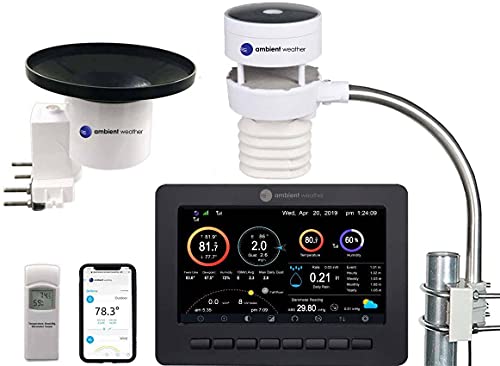
Ambient Weather WS-5000
Choose the WS-5000 when you want faster ultrasonic wind updates, a rain gauge that can be mounted and serviced separately, the premium TFT console, and room to add specialized sensors later.
Confirm the listing includes the WS80 array, WH40 rain gauge, WH32B indoor sensor, TFT console, power adapter, and expected mounting hardware.
WS-5000 specifications at a glance
| Decision point | What the current system provides |
|---|---|
| Outdoor array | WS80 ultrasonic wind, outdoor temperature and humidity, UV, and solar radiation sensors in a solar-assisted array. |
| Rain measurement | Separate WH40 extra-large tipping-bucket rain gauge with bubble level and removable debris filter. |
| Indoor measurements | Separate WH32B temperature, humidity, and barometric-pressure sensor. |
| Update cadence | Outdoor observations update about every five seconds, the manual lists 4.9 seconds and a 4.75-second reporting interval in separate specification sections. |
| Sensor-to-console radio | 915 MHz, rated to 1,000 feet line of sight and typically up to 300 feet under real-world conditions. |
| Home Wi-Fi | 2.4 GHz Wi-Fi from the console, the console must be on AC power for Wi-Fi operation. |
| Mounting | WS80 array and WH40 gauge accept 1.25- to 2-inch poles, the pole or mounting system is not included. |
| Expansion | Supports model-specific temperature, probe, pool, refrigerator/freezer, leaf-wetness, soil, leak, lightning, particulate, and indoor air-quality sensors. |
Ranges are best-case manufacturer ratings, not promises for every house. Walls, metal siding, terrain, other 915 MHz devices, and console placement can reduce reception.
The split sensor layout is the WS-5000’s main advantage
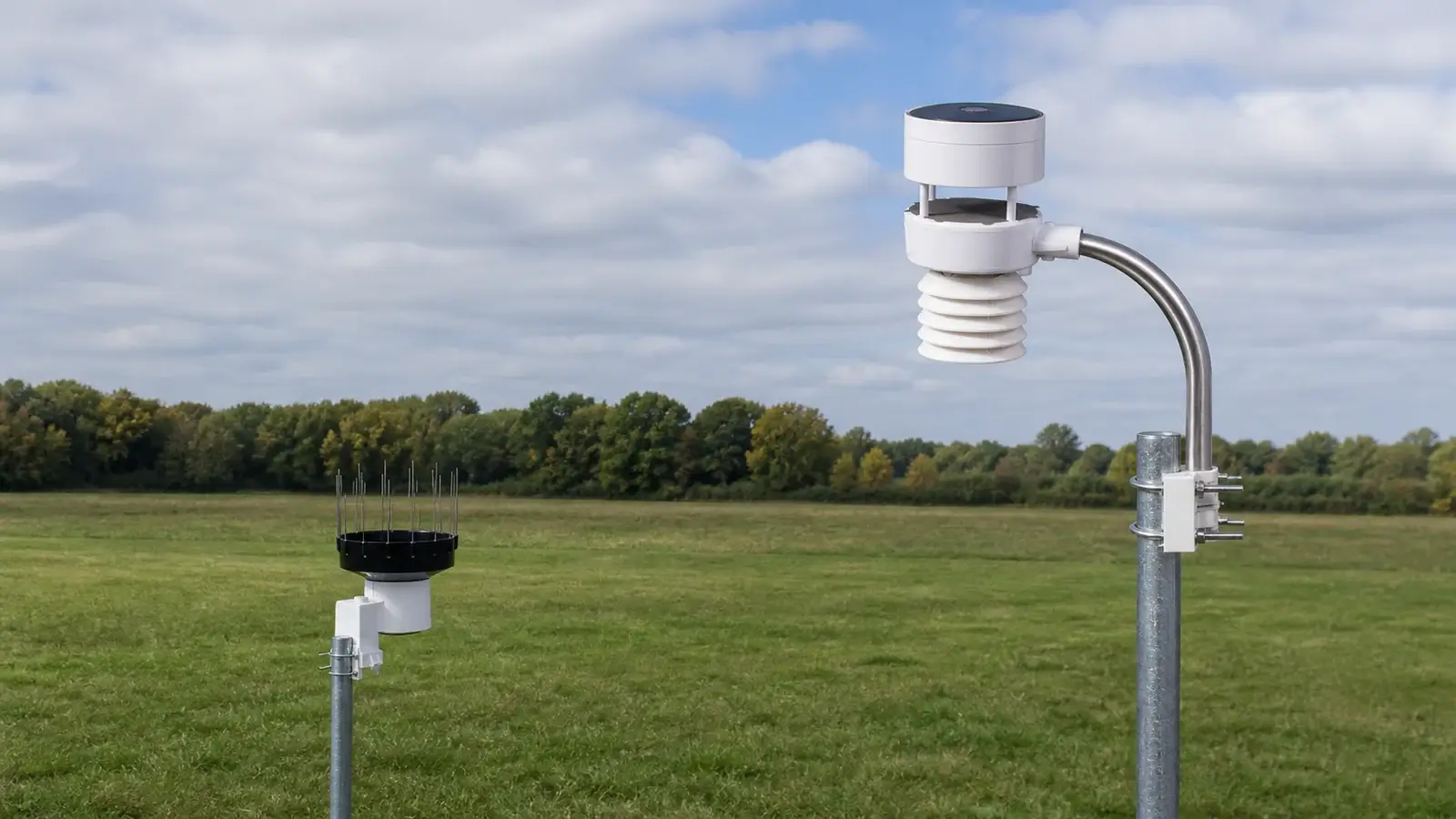
Many consumer stations force temperature, wind, and rain to share one mounting point. That is convenient, but the best location for one measurement is often a compromise for another. Wind benefits from height and open exposure. A tipping-bucket rain gauge needs a stable, level platform, minimal splash, and easy access for cleaning. Temperature and humidity need distance from pavement, walls, rooftops, air-conditioning exhaust, and other heat sources.
The WS-5000 does not fully separate every instrument—the temperature, humidity, UV, solar, and wind sensors still live together in the WS80 array—but it does separate rain. That gives an owner a much better chance of placing the wind sensor high and open while keeping the rain gauge lower, level, and serviceable.
Accuracy depends on exposure, not the word “ultrasonic”
The current manual rates outdoor temperature to ±2°F, outdoor humidity to ±5%, rain to ±5%, wind direction to ±5 degrees, and wind speed to ±1 mph below 22 mph or ±5% at and above 22 mph. Those are instrument specifications under defined conditions. They do not correct a poor site.
Ambient Weather’s own site guidance recommends keeping the array at least five feet from buildings, structures, the ground, or a rooftop, mounting over natural vegetation, and using an obstruction rule based on four times the height difference between the sensor and the tallest nearby obstruction. Few residential yards can meet ideal meteorological exposure in every direction, so the honest goal is a documented, repeatable compromise.
For cleaner wind data
Put the WS80 as high and open as practical, away from roof edges, trees, fences, and walls that create turbulence. A rigid pole matters. Movement and vibration do not improve any measurement.
For cleaner rain data
Keep the WH40 level, stable, and clear of overhangs. Place it where the funnel can be inspected after leaf fall, pollen, insects, or bird activity. A swaying mount can create false tips.
For cleaner temperature data
Avoid pavement, dark roofs, walls, exhausts, and irrigation. The passive radiation shield needs airflow. Calibration cannot fully repair a sensor that is repeatedly heated by its surroundings.
For useful pressure data
The WH32B measures pressure indoors. Relative pressure should be calibrated carefully against a trustworthy nearby reference after allowing the sensor to stabilize.
The manufacturer specifications are useful performance boundaries, but the reading quality on any property is still installation-dependent. The WS-5000’s practical advantage is not a promise of automatic accuracy. It is the extra freedom to give wind and rain better individual locations.
Ultrasonic wind: faster and simpler, but not maintenance-free
The WS80 measures wind without spinning cups or a mechanical vane. That removes bearings and moving parts that can wear, bind, or respond sluggishly, and the roughly five-second update cycle makes gust changes feel much more immediate than a 16-second consumer array. It is a meaningful upgrade for owners who watch wind closely.
“No moving parts” does not mean “no cleaning.” Spider webs, insects, dust, ice, and debris inside the ultrasonic measurement volume can freeze or distort readings. Ambient Weather’s support guidance specifically calls for inspecting the sonic area and cleaning it with a damp cloth. The solar panel and radiation sensor also need periodic cleaning.
The ultrasonic heater is optional, not included in the standard package. It can help in freezing conditions, but it requires its own power arrangement and should not be treated as a guarantee against every icing event. Buyers in snow and freezing-rain climates should budget for access, power, and winter inspection before placing the array on a difficult roof.
The separate rain gauge is more than a convenience
The WH40 uses a tipping bucket and transmits much less frequently than the WS80 wind array, which is normal because rain totals do not need five-second radio updates. Its large funnel, bubble level, removable coil filter, and independent mounting options make it easier to set up and maintain well.
Expect routine ownership work. The current manual calls for rain-gauge cleaning every few months and recommends checking the solar panel, sensor surfaces, and batteries on a regular schedule. Leaves, pollen, insects, and bird debris can affect any consumer tipping-bucket gauge. The WS-5000 makes that work easier by letting the gauge live within reach. It does not eliminate the work.
The TFT console is still one of the strongest reasons to buy
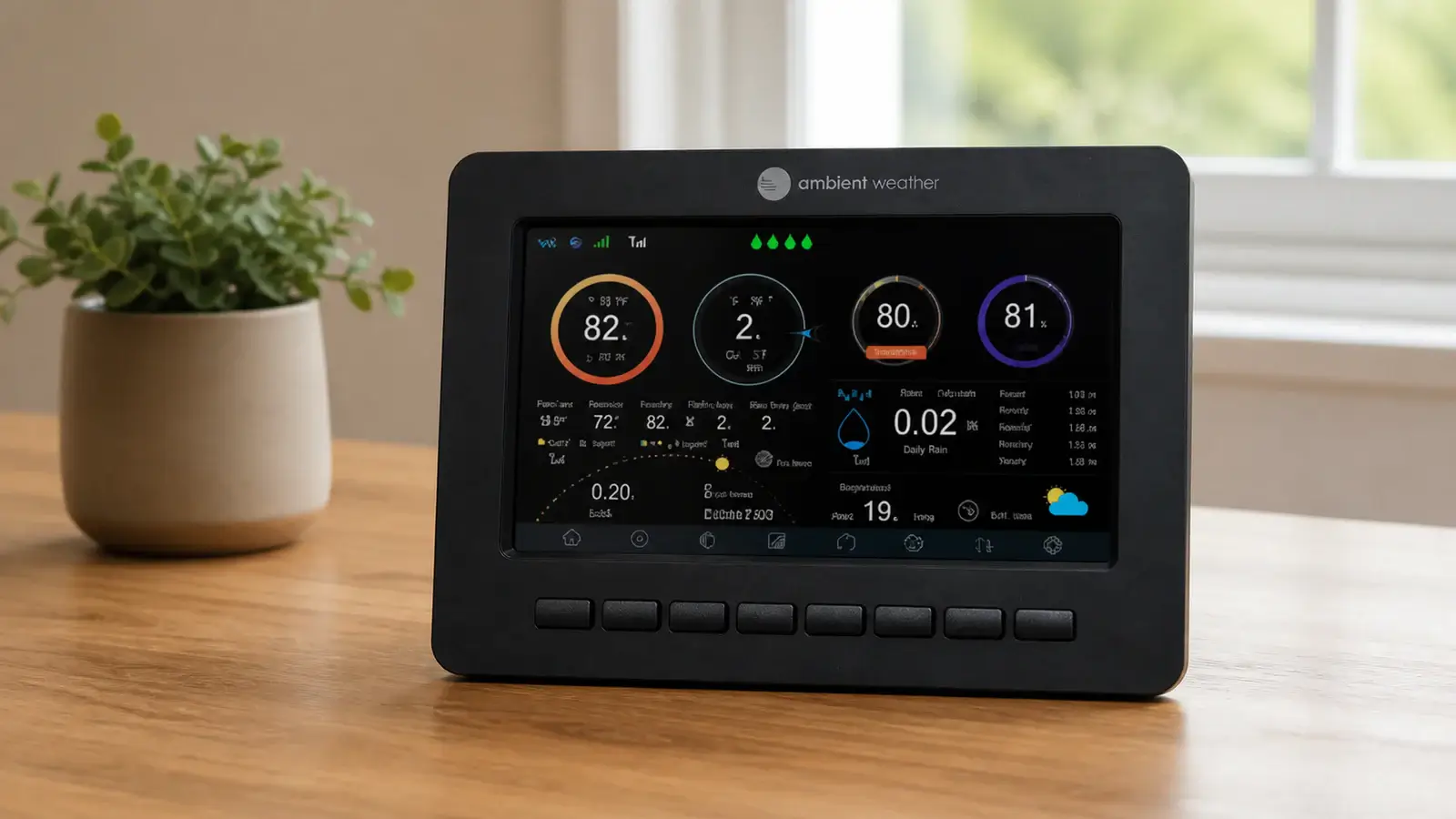
The included color TFT console is designed for people who want a useful local dashboard, not only an app. It shows current conditions, records minimums and maximums with timestamps, provides on-console graphs, supports alarms and calibration, and can archive history to an optional microSD card for export.
Because the WH32B is separate, indoor temperature, humidity, and pressure are not tied to the console’s location. That matters when the best viewing spot for the screen is near a television, kitchen appliance, sunny wall, or other source that would bias a built-in sensor.
Connectivity: strong local display plus cloud access
The console connects to a 2.4 GHz home network and publishes to Ambient Weather Network (AWN), where owners can view dashboards, receive alerts, share conditions, and use supported integrations. The current manual documents IFTTT, Alexa, Google Assistant, and custom-server workflows. Ambient Weather also offers an API for owners and developers.
Cloud features are valuable, but they depend on the console, router, internet connection, Ambient Weather’s service, and any third-party integration in the chain. Third-party capabilities can change. If an automation controls irrigation or another meaningful device, build in safe defaults rather than assuming every upload or alert will arrive.
Firmware support is better than it used to be. The current manual documents automatic or manual host-firmware checks and Wi-Fi firmware updates from the console for supported hardware. Older units may still use microSD or app-based procedures, so follow the instructions that match the console revision actually received.
A broad expansion system—if you choose compatible models
The WS-5000 is a platform as much as a bundled station. The current manual lists support for optional indoor air quality, indoor and outdoor particulate, temperature-humidity, probed temperature, pool, refrigerator/freezer, leaf-wetness, soil-moisture, leak, and lightning sensors.
Channel limits are model-specific. For example, the current manual lists one AQIN, one indoor and one outdoor PM2.5 monitor, one lightning detector, four leak detectors, and sixteen soil-moisture channels. Several temperature, probe, pool, refrigerator/freezer, and leaf-wetness products share one eight-channel group rather than receiving eight channels each.
Useful first add-ons
Extra temperature-humidity sensors make sense for a greenhouse, basement, attic, workshop, or detached building—provided the 915 MHz path is reliable.
Property monitoring
Leak, soil-moisture, leaf-wetness, pool, and probe sensors can turn AWN into a broader property dashboard, but every added device brings batteries, placement, and maintenance.
Hazard awareness
Lightning and particulate sensors add useful local context. They are not substitutes for official warnings, certified life-safety devices, or regulatory air-quality monitoring.
Check the exact accessory name against Ambient Weather’s current compatibility list before buying. Similar-looking sensors and older model numbers are not automatically interchangeable, and firmware support can vary by console age.
Installation: plan the site before assembling the pole
- Bench-test the console, WS80, WH40, and WH32B together in an accessible location before permanent mounting.
- Choose separate wind and rain sites on purpose. Do not default to one pole just because it is easier on installation day.
- Use a rigid 1.25- to 2-inch pole or compatible mounting system and hand-tighten the U-bolts according to the support guidance.
- Point the WS80 north marker correctly and make sure the array and rain gauge are level where required.
- Confirm the 915 MHz signal path before drilling or climbing, metal siding and walls can reduce range sharply.
- Keep both outdoor components reachable for cleaning, battery replacement, reset access, and winter inspection.
What long-term ownership looks like
A realistic maintenance calendar is simple: inspect the rain funnel and ultrasonic opening after dirty weather, clean the rain gauge, solar panel, and optical surfaces about every three months, check mounts and fasteners, review battery condition, and verify readings against a reasonable local reference when something changes suddenly.
The WS-5000 is easier to service than an all-in-one array when rain is mounted low, but a high ultrasonic sensor can still be awkward. That is the tradeoff of better wind exposure. Design the mount so the array can be lowered or reached safely—especially if icing, spiders, birds, or airborne debris are common.
Ambient Weather’s current manual lists online support, email support, and telephone technical support. Replacement consoles and components have been offered, but parts availability and warranties can change. Verify current terms at the time of purchase rather than relying on an older review.
WS-5000 strengths and limits
What it does well
- Fast ultrasonic wind updates with no cups or vane.
- Separate, serviceable tipping-bucket rain gauge.
- Strong local TFT display and separate indoor sensor.
- Long rated sensor range and broad add-on ecosystem.
- AWN remote access, alerts, integrations, and data export options.
What to accept before buying
- Premium price compared with simpler Ambient stations.
- Multiple outdoor components and batteries to install and maintain.
- Ultrasonic sensing can still be affected by debris and icing.
- 2.4 GHz Wi-Fi and cloud services add setup dependencies.
- Best results require deliberate siting and a mount purchased separately.
Who should buy the WS-5000?
Buy it if: wind data matters, you have separate locations that improve wind and rain exposure, you will use the TFT console, or you expect to build a larger sensor network. In those cases, the WS-5000’s architecture—not just its specification sheet—can justify the premium.
Skip it if: you mainly want temperature, humidity, rainfall, and basic wind data at the lowest sensible cost, the outdoor components will be mounted together anyway, or the console and optional-sensor system will go mostly unused.
For a lower-cost Ambient Weather system with the same premium console family, start with our WS-2000 review. For an even simpler value-focused package, see the WS-2902 review. Those are alternatives, not substitutes for deciding whether the WS-5000’s separated rain gauge and ultrasonic wind sensor solve a real siting need on your property.
WS-5000 FAQ
Is the Ambient Weather WS-5000 a professional weather station?
The answer is no. It is an advanced home or enthusiast system. The current manual explicitly describes it as a home weather product and says it should not be used for medical or public-safety decisions. Good siting can produce useful local observations, but the station is not a certified research or public-warning instrument.
Does the WS-5000 include the ultrasonic heater?
The answer is no. Wind-sensor heating is an optional capability, and the heater requires its own power arrangement. Confirm compatibility and installation requirements before ordering it.
Can the rain gauge and wind sensor be mounted separately?
The answer is yes. The WS80 ultrasonic array and WH40 rain gauge are separate wireless components. That is one of the system’s most important advantages because wind and rain have different siting and maintenance needs.
How often does the WS-5000 update?
The current product page lists 4.9-second updates, while the manual also gives a 4.75-second sensor reporting interval. “About every five seconds” is the most honest shorthand. The indoor sensor and rain gauge use slower intervals.
Does it work with 5 GHz Wi-Fi?
The console uses 2.4 GHz Wi-Fi. A dual-band router is fine when it provides a compatible 2.4 GHz network, but guest networks, band steering, mesh systems, or some security settings can complicate setup.
How far can the outdoor sensors be from the console?
Ambient Weather rates the 915 MHz link to 1,000 feet in open line-of-sight conditions and says about 300 feet is more typical. Walls, metal, terrain, electronics, and interference can reduce that substantially.
Does the WS-5000 need maintenance?
The answer is yes. Expect to clean the rain funnel, solar panel, and sensor surfaces, remove insects or webs from the ultrasonic opening, inspect the mount, and replace batteries. The separate rain gauge improves access but does not make the station maintenance-free.
Can the WS-5000 send data to Weather Underground?
The current manual says direct console uploads to Weather Underground have been replaced by sharing through Ambient Weather Network. Because service integrations change, verify the current AWN sharing options during setup.
Bottom line
The Ambient Weather WS-5000 is a well-designed premium home weather station when the split sensor layout will be used as intended. Its best qualities are practical: faster ultrasonic wind readings, no moving wind parts, a rain gauge that can be leveled and serviced separately, a capable TFT console, and a deep add-on ecosystem. It is not automatically more accurate than a cheaper station mounted well, and it is not maintenance-free. Buy it because its architecture fits your property and priorities—not because “ultrasonic” sounds professional.
Related Station Guides
Use these practical guides to get more reliable readings and a better ownership experience:
- Mounting ideas and options — Compare practical mounting locations, poles, brackets, and service-access tradeoffs.
- Installation and siting — Place the sensors where buildings, pavement, trees, and roofs will not bias the readings.
- Maintenance checklist — Keep the rain collector, radiation shield, wind sensors, batteries, and mounts in working order.
Sources and review basis
This evidence-checked review was verified against Ambient Weather’s current product page, current manual, support documentation, compatibility information, and official installation video. Product configuration and support details were checked in August 2026.