
Ambient Weather WS-1965 Review: Best Budget Entry to AWN?
The WS-1965 puts Ambient Weather Network access, core wind/rain/temperature measurements, and unusually broad optional-sensor support into a lower-priced package with a very small color console.
Affiliate disclosure: WXObservation may earn a commission from qualifying Amazon purchases, at no additional cost to you. Availability, seller, bundle contents, and prices can change, confirm the exact model number before ordering.
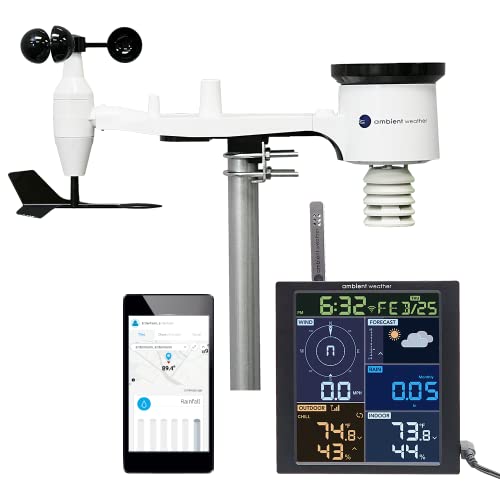
Ambient Weather WS-1965
A compact all-in-one outdoor array, small color Wi-Fi console, Ambient Weather Network access, and support for nine optional sensor models create an inexpensive path into Ambient’s ecosystem.
Confirm model WS-1965. The similar WS-1900 is console-only/local, while WS-2902, WS-2000, WS-4000, and WS-5000 use different displays and sensor capabilities.
Where WS-1965 fits in the Ambient lineup
Ambient positions WS-1965 below WS-2902, WS-2000, WS-4000, and WS-5000. It retains Wi-Fi, a color display, an all-in-one outdoor array, and AWN access. The cost reductions are visible: the console is much smaller, the array omits UV and solar-radiation sensors, and the wind/rain/temperature hardware is a simpler battery-powered design.
The surprise is expansion. Ambient lists compatibility with WH31E, WH31P, WH31PF, WH31L-AA, WH31SM, WH31LA, PM25, PM25IN, and AQIN families. The eight-channel temperature/probe/pool group shares eight total console channels, several other accessories pass through to AWN rather than appearing on the small display.
Specifications that matter
| Decision point | WS-1965 |
|---|---|
| Core measurements | Outdoor temperature/humidity, wind speed/direction, rainfall, indoor temperature/humidity, pressure, forecast, dew point, heat index, and wind chill. |
| Not included natively | UV, solar radiation, and lightning. Lightning is available only through the optional compatible sensor path. |
| Update interval | 16 seconds for the main outdoor array. |
| Stated range | 300 ft line of sight under favorable conditions. |
| Array size | Approximately 15.5 × 6.5 × 4.5 inches. |
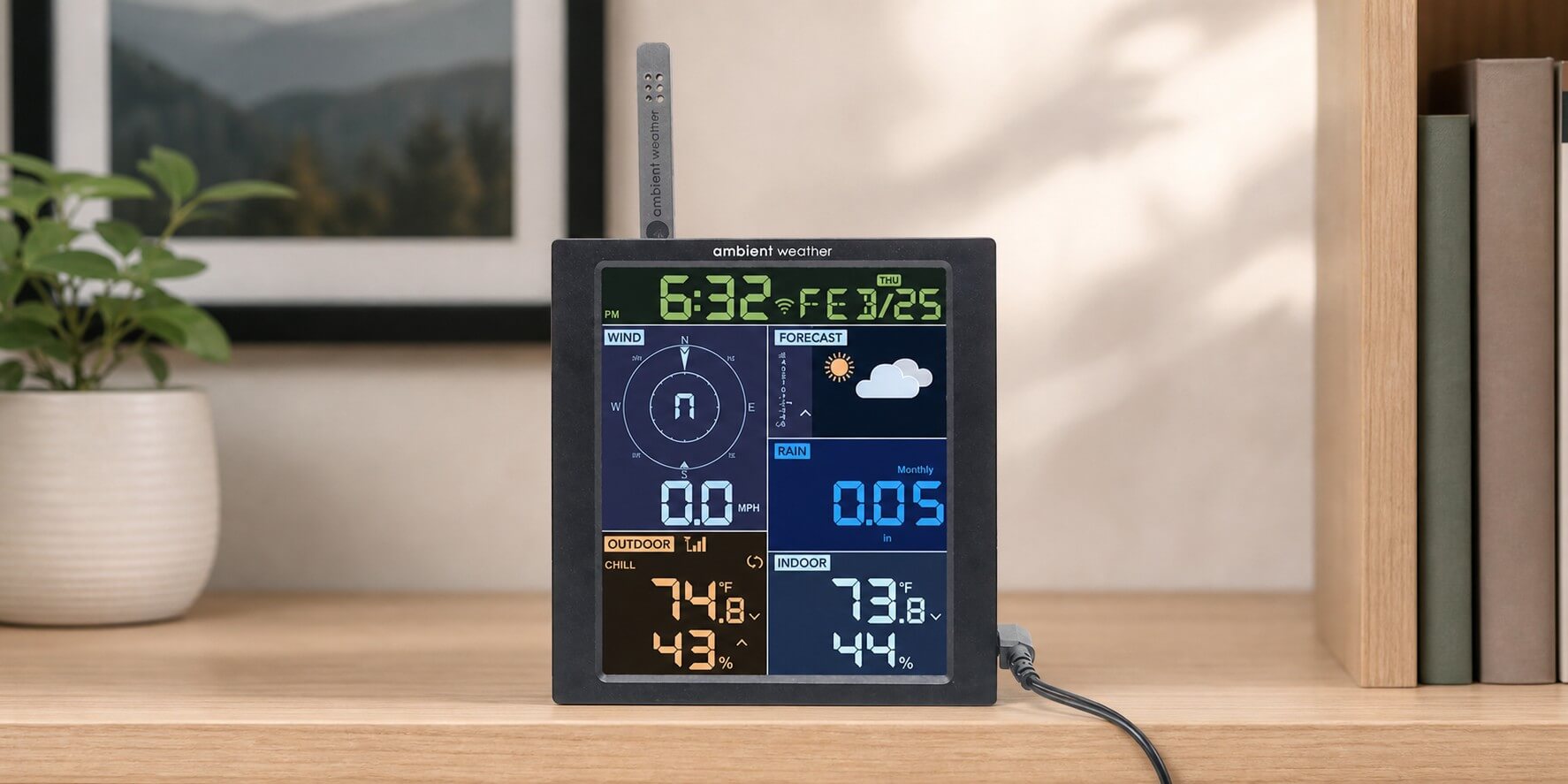
| Console size | Approximately 4.25 × 4.06 × 1 inch with antenna up. |
| Power | Main array uses two AA batteries. Display can run from USB power or batteries, with much shorter battery life when Wi-Fi is active. |
| Network | 2.4 GHz Wi-Fi to Ambient Weather Network, local web interface is used for some setup and calibration functions. |
The small console is either a feature or the deal-breaker
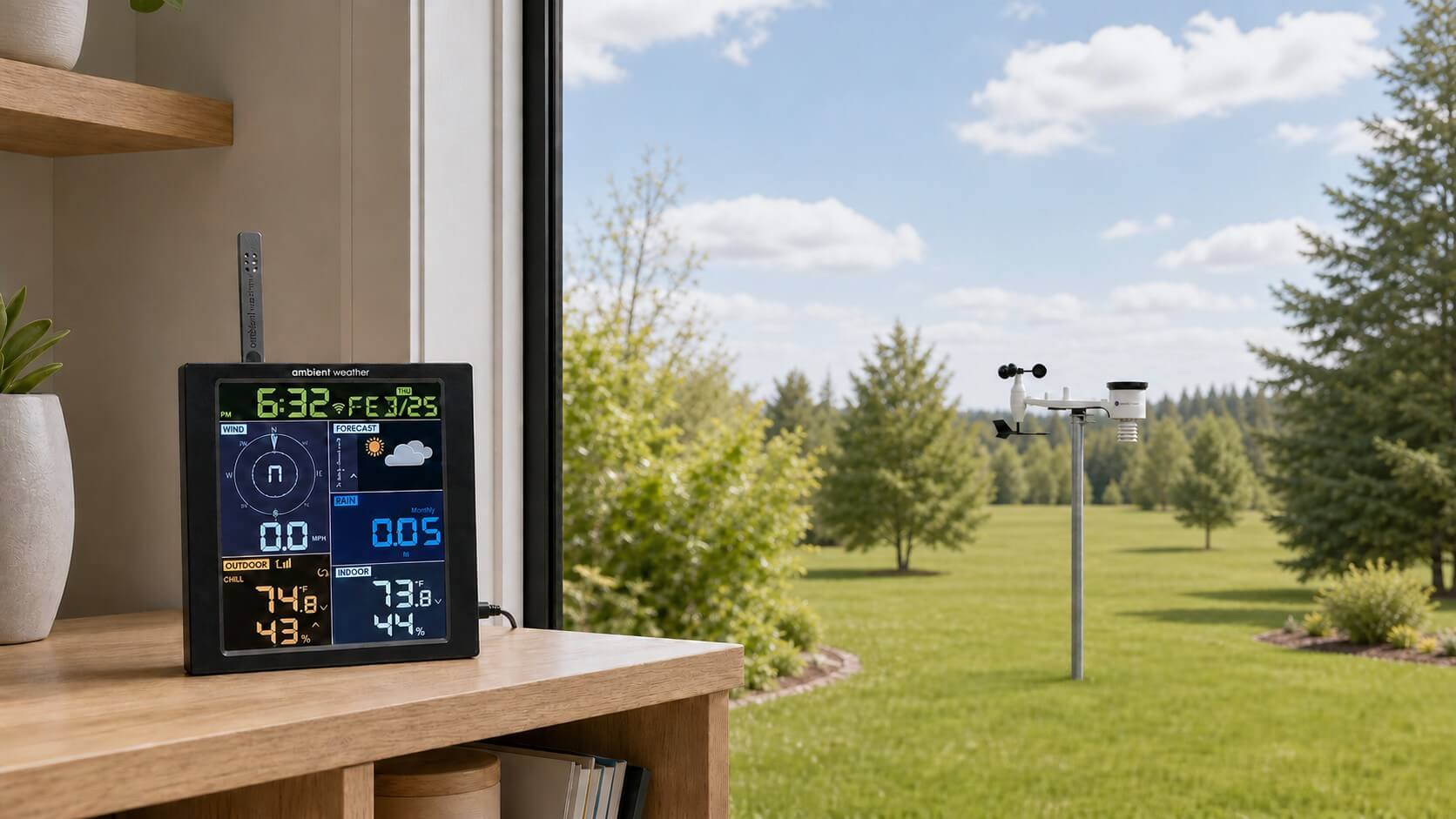
The display is closer to a compact desktop monitor than the wide consoles many buyers picture. It shows a wind compass, forecast, rainfall, indoor/outdoor readings, time, and date in a dense grid. The large main digits remain readable, but there is less room for history and secondary detail than on WS-2000 or WS-5000.
Battery operation is possible, but the manual’s Wi-Fi battery-life estimate is measured in months rather than years. For an always-on connected station, plan to use the supplied USB power path and treat batteries as portability or backup—not the normal permanent power source.
Ambient Weather Network and optional sensors
AWN is the strongest reason to buy the WS-1965. The standard account provides current conditions, mapping, push/email alerts, basic graphs, and one year of history under Ambient’s current description. AWN+ is optional and adds longer history, advanced graphs, SMS alerts, and additional map/forecast features. Core station use does not require the paid tier.
Accessory behavior is not identical. Some sensors appear on the console. Others are passed through for viewing on AWN. Before buying an air-quality, lightning, leak, soil, freezer, or pool sensor, check the exact channel limit and where the reading appears. “Compatible” does not always mean “visible on every screen.”
How to interpret the accuracy specifications
The current manual publishes useful limits, including approximately ±1°F for outdoor temperature, ±5% relative humidity, ±0.08 inHg pressure, ±10% rainfall, ±10 degrees wind direction, and wind speed stated as ±2.2 mph or 10%, depending on speed. These are manufacturer specifications under defined conditions, not a promise that a poorly placed backyard installation will stay inside those numbers.
Before changing calibration, compare instruments at the same place and time. A sunny mast, a wall-heated shield, a turbulent roofline, or a partly blocked rain funnel can create a larger error than the sensor electronics. Correct exposure and mechanical problems first, then use the WS-1965 web interface for small documented offsets. Calibration should reconcile a known reference—not force the station to match a distant airport or phone forecast.
Placement and calibration
Like other one-piece arrays, WS-1965 forces temperature, rain, and wind into a compromise site. Mount it level on a rigid mast, give the rain funnel a clear sky view, open the wind exposure, and keep the shield away from roofs, walls, asphalt, HVAC exhaust, and reflected afternoon sun. Orient the wind vane as the manual directs before tightening the U-bolts.
- Assemble cups, vane, funnel, coil filter, batteries, and mast hardware on the ground.
- Run an indoor pairing and Wi-Fi test before permanent mounting.
- Use the local web interface to calibrate only after correcting placement and comparing against a suitable reference.
- Clean the rain path and inspect cup/vane movement on a regular schedule.
- Add bird spikes when perch activity causes debris or false rain.
WS-1965 versus other Ambient stations
| Model | Why step up | Why choose WS-1965 |
|---|---|---|
| WS-2902 | Larger display plus UV and solar radiation. | Lower cost and broader optional-sensor compatibility in several categories. |
| WS-2000 | Much larger advanced console and a separate indoor sensor. | Core AWN experience for substantially less money. |
| WS-5000 | Ultrasonic wind, separate rain collector, 4.9-second update, and 1000-ft range. | Simpler and dramatically less expensive for ordinary yards. |
Who should buy the WS-1965?
The best buyer wants a low-cost connected station now and expects to add targeted sensors later. A gardener might add soil and leaf-wetness monitoring. A homeowner could add leak or freezer sensors. A pool owner can use a compatible floating thermometer. Because several accessories pass through to AWN, the phone/web dashboard—not the tiny console—should be considered the long-term center of the system.
Choose WS-2902 instead if UV, solar radiation, and a wider console matter more than those expansion categories. Step to WS-2000 when the display is central and you want richer controls. Buyers interested mainly in a simple local screen with no ecosystem plans can spend less elsewhere. The WS-1965’s value comes from AWN and compatibility, not from the physical display alone.
Pros and limitations
- Low-cost access to Ambient Weather Network.
- All core backyard weather measurements.
- 16-second update interval is competitive at the price.
- Broad optional-sensor compatibility.
- Compact array and console fit small spaces.
- Console is much smaller than it appears in isolated product photos.
- No native UV or solar-radiation measurement.
- All-in-one outdoor placement compromises ideal exposure.
- Wind update is slower than the WS-5000 enthusiast tier.
- Accessory readings do not all appear on the console.
Does the WS-1965 measure UV or solar radiation?
The answer is no. Ambient’s current comparison table lists neither measurement for WS-1965. WS-2902 and higher models add them.
How large is the WS-1965 display?
Ambient lists it at roughly 4.25 inches wide by 4.06 inches high, making it almost square and notably smaller than the company’s other connected consoles.
Can it use additional temperature sensors?
The answer is yes. It supports up to eight shared channels across compatible WH31E, WH31P, and WH31PF sensor families, subject to the channel rules in the manual.
Does the WS-1965 require AWN+?
The answer is no. A standard AWN account provides the core remote dashboard and current standard-tier features. AWN+ is an optional upgrade.
Can it upload to Weather Underground?
The current product emphasis is Ambient Weather Network. If a specific third-party service is mandatory, verify the current manual and firmware before purchase rather than assuming support from the Wi-Fi label.
Bottom line
WS-1965 is not a miniature WS-5000. It is a deliberately basic station with a tiny console, core sensors, and a surprisingly capable AWN expansion path. That combination makes it one of the most interesting values over $100—especially for buyers who want remote monitoring and future leak, soil, pool, freezer, lightning, or air-quality sensors without paying for a premium console today.
Choose it only after confirming the compact console and lack of native UV/solar data fit your priorities.
Sources and verification
- Ambient Weather WS-1965 product page and comparison table
- Ambient Weather WS-1965 manual, version 1.23
- Ambient Weather manuals and downloads
- Amazon product page checked for exact ASIN/model match. Price and availability are intentionally omitted because they change.
Related weather-station reviews
WS-2902 review
Compare the more established Ambient all-in-one with UV and solar measurements.
WS-2000 review
Move up to a larger console, separate indoor sensor, and broader enthusiast controls.
WS-5000 review
See what faster ultrasonic wind and separated rain add at the top of the range.
Related Station Guides
Use these practical guides to get more reliable readings and a better ownership experience:
- Installation and siting — Place the sensors where buildings, pavement, trees, and roofs will not bias the readings.
- All-in-one station tradeoffs — Learn where integrated arrays simplify setup and where shared placement creates compromises.
- Share station data online — See why owners publish observations and what to consider before connecting a network.