
Ambient Weather WS-5000 vs WS-4000: Which Is Better?
Both stations combine ultrasonic wind with Ambient Weather’s premium TFT console. The buying decision is mostly about rainfall and layout: the WS-5000 separates a traditional tipping-bucket gauge, while the WS-4000 keeps haptic rain inside one compact, no-moving-parts outdoor array.
Affiliate disclosure: WXObservation may earn a commission from qualifying Amazon purchases, at no additional cost to you. Availability, seller, bundle contents, and prices can change. Confirm the exact model and included components before ordering.
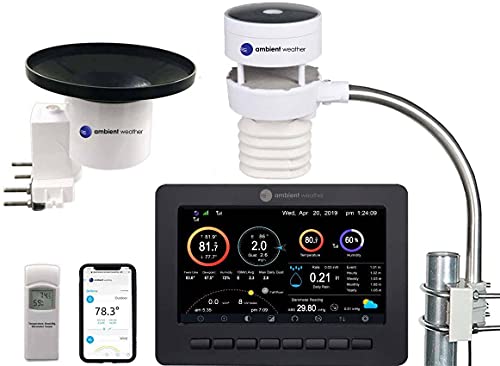
Ambient Weather WS-5000
Choose the WS-5000 when the wind array belongs high and open but the rain gauge belongs lower, level, and within easy reach. Its separate WH40 uses familiar tipping-bucket measurement.
Confirm the listing includes the WS80 array, separate WH40 rain gauge, WH32B indoor sensor, TFT console, power adapter, and expected brackets.

Ambient Weather WS-4000
Choose the WS-4000 when one rigid outdoor site works, compact hardware matters, and you are comfortable comparing and tuning its haptic rainfall across multiple rain rates.
Confirm the listing is the standard WS-4000 bundle and includes the outdoor array, WH32B indoor sensor, TFT console, and power adapter. The mount is extra.
WS-5000 vs WS-4000 comparison
| Decision point | WS-5000 | WS-4000 |
|---|---|---|
| Best fit | Owners who prioritize separately sited, serviceable rainfall and flexible outdoor placement. | Owners who prioritize compact hardware, fewer moving parts, and lower total cost. |
| Outdoor architecture | WS80 wind-temperature-humidity-UV-solar array plus separate WH40 rain gauge. | One compact array combines wind, haptic rain, temperature, humidity, UV, solar, and light. |
| Wind sensing | Ultrasonic, no cups or mechanical vane. | Ultrasonic, no cups or mechanical vane. |
| Outdoor update behavior | WS80 observations update about every five seconds, separate sensors use their own intervals. | The manual lists a 4.9-second outdoor-sensor update rate. |
| Rain measurement | Separate WH40 tipping bucket with funnel, level, filter, and mechanical tipping mechanism. | Haptic or piezoelectric impact sensing with calibration factors across rain-rate bands. |
| Siting flexibility | Wind and rain can occupy different locations. | Wind, rain, temperature, and humidity share one location. |
| Rated radio range | Up to 1,000 ft line of sight, about 300 ft is the manufacturer’s typical figure. | Up to 1,000 ft in open air, about 300 ft is the manufacturer’s typical figure. |
| Console and indoor sensor | Premium TFT console family plus separate WH32B indoor temperature-humidity-pressure sensor. | Premium TFT console family plus separate WH32B indoor temperature-humidity-pressure sensor. |
| Mounting | WS80 and WH40 accept conventional pole mounting in the sizes documented for each component, two sites may be desirable. | Fits a 1-inch vertical pole and uses model-specific pole or tripod options sold separately. |
| Rain upkeep | Keep the funnel, filter, level, and tipping mechanism clean and stable. | Keep the impact surface and mount clean and rigid, validate and tune rainfall periodically. |
| Relative ownership cost | Usually higher station and mounting cost, with more outdoor components. | Usually lower purchase and mounting cost, with one primary outdoor component. |
Manufacturer radio ranges are best-case figures, not guarantees for every property. Walls, metal, terrain, interference, and console placement can reduce either system’s reception.
Haptic rain versus a separate tipping bucket
The WS-4000 measures rain impacts on a piezoelectric or haptic surface. It has no funnel, bucket, or tipping mechanism, so there is less mechanical hardware to clog or wear. The trade is interpretation: vibration, wind, mounting rigidity, drop size, and rain intensity can influence the signal.
Ambient Weather provides multiple WS-4000 calibration factors for different rain-rate bands. That matters because one blanket percentage may not correct light, moderate, and heavy rain equally. A careful owner should compare meaningful events against a trustworthy local gauge, change one rate band at a time, and recheck after moving the array or changing its mount.
The WS-5000 uses a separate WH40 tipping bucket. Its strengths are familiarity and physical separation. The gauge can sit on a rigid, level support with open sky while the WS80 is placed higher for wind. The funnel, filter, and tipping mechanism still need inspection because leaves, pollen, insects, splash, a bad level, or a swaying support can distort totals.
Fewer mechanical components
The WS-4000 is attractive when a rigid one-pole installation works and the owner is willing to validate rainfall across multiple events rather than treating factory settings as final.
Familiar measurement and separate access
The WS-5000 is stronger when the rain gauge needs its own level, reachable location or the owner prefers a familiar mechanism over rate-band tuning.
Modular versus compact installation
The WS-5000’s modularity is useful only when the separate pieces are placed deliberately. The WS80 can prioritize clean airflow and height. The WH40 can prioritize level support, open sky, and service access. That solves a real meteorological conflict, but it means more hardware, batteries, radio links, and mounting work.
The WS-4000 asks one small cylinder to represent wind, rain, temperature, and humidity. It is simpler to install and visually discreet. One site must still balance different exposure needs, and the haptic sensor makes pole rigidity especially important. A swaying mast can create the wrong kind of signal for an impact-based rain sensor.
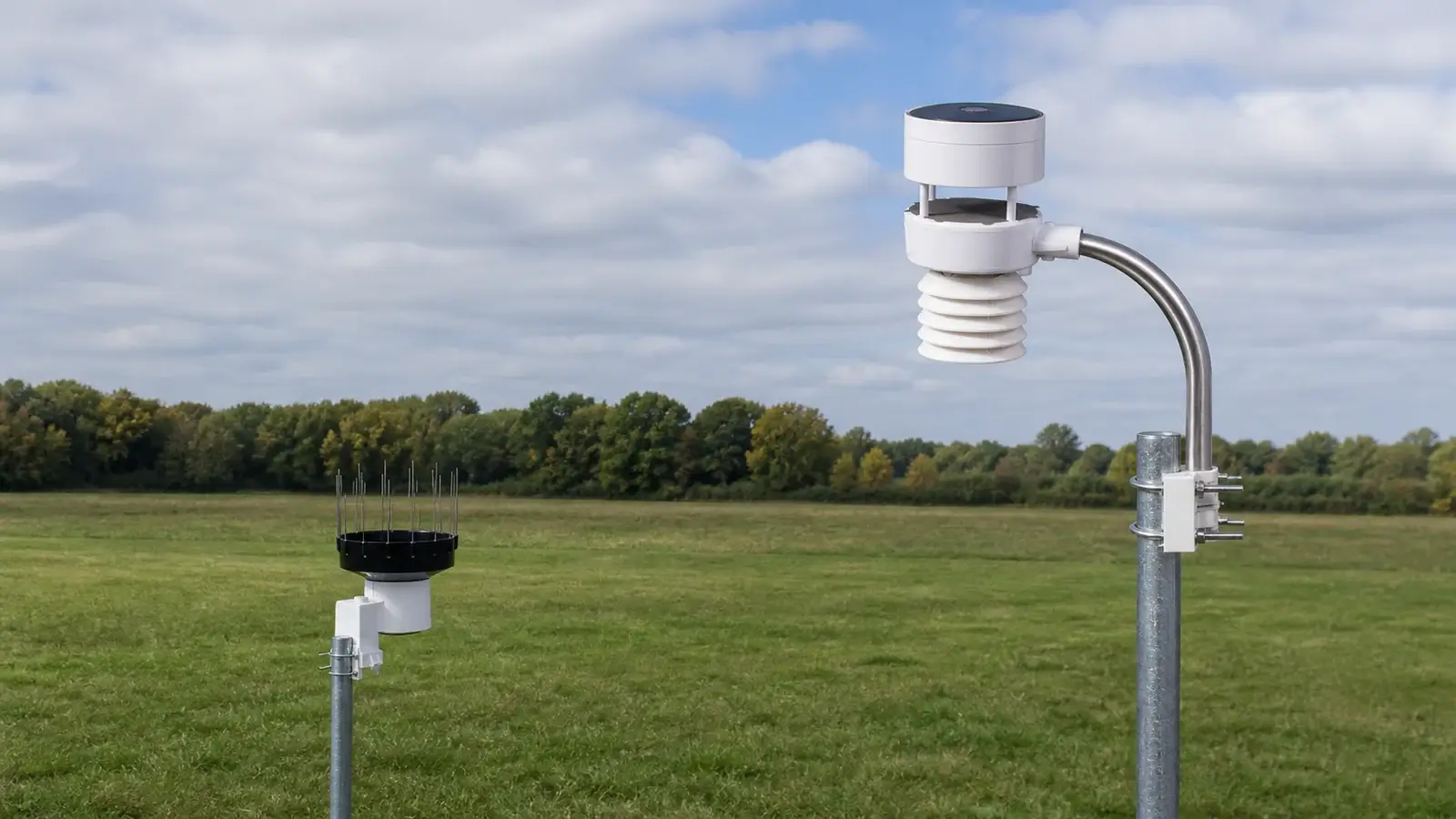
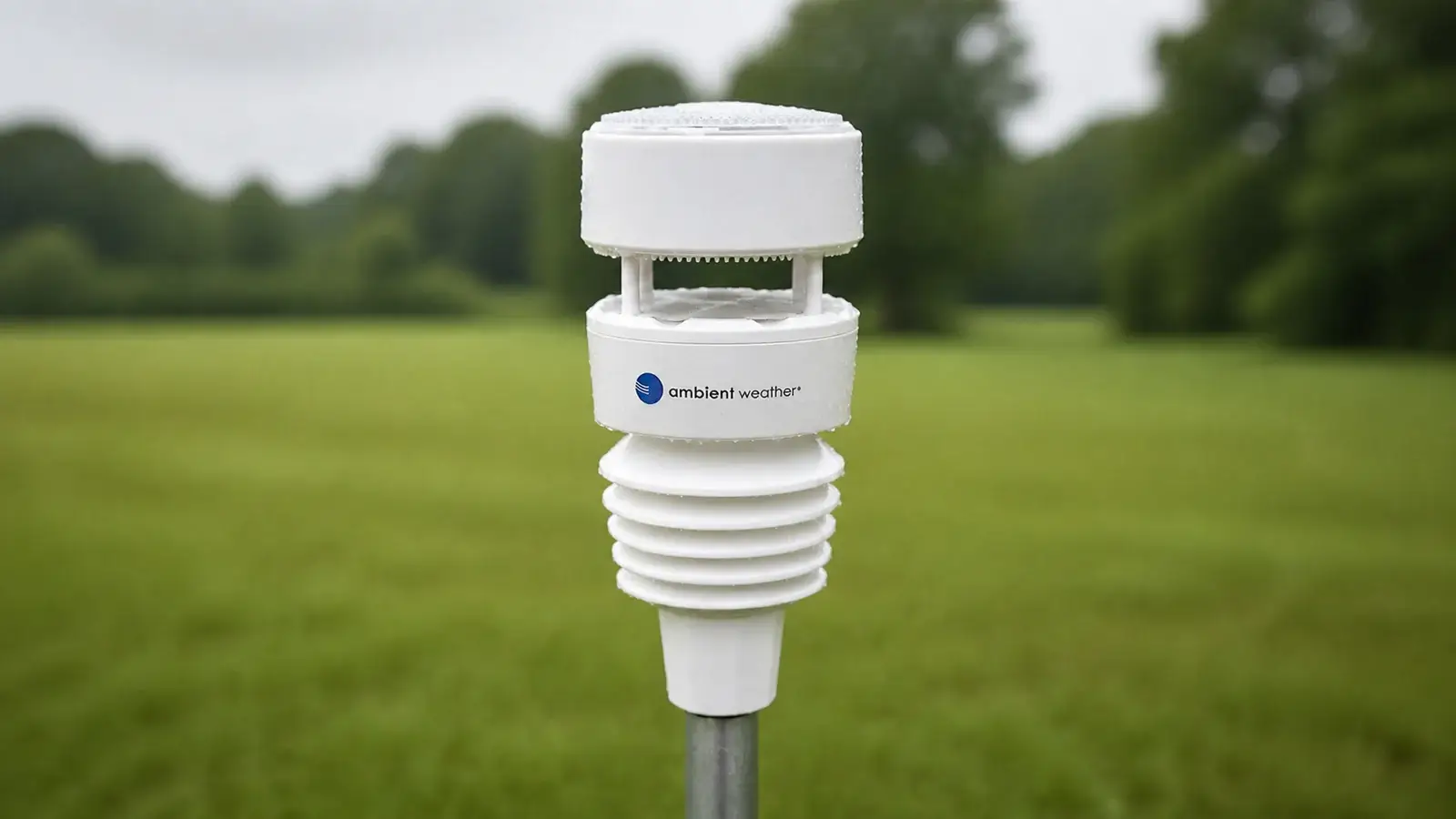
The wind, console, and platform are close
Both models use ultrasonic wind and list outdoor updates at roughly five seconds. Both remove cups and a mechanical vane, so neither has a meaningful architecture advantage for moving wind parts. Debris, insects, webs, and icing can still affect ultrasonic openings, and both arrays need safe cleaning access.
Both current bundles use Ambient Weather’s premium TFT-console family and a separate WH32B indoor sensor. They share local display, alarms, calibration, historical views, graphing, optional microSD functions, 2.4 GHz Wi-Fi, and Ambient Weather Network access. Hardware and firmware revisions can vary by production date, so verify the current bundle rather than assuming every console is identical.
The optional-sensor ecosystems also overlap substantially. Extra temperature-humidity, probes, leak, soil, leaf-wetness, particulate, air-quality, and other categories are available in model-specific combinations. Exact sensor number, channel group, firmware, console display, and AWN behavior must be checked before purchase.
Which station has better real-world accuracy?
Neither model is automatically more accurate simply because it is ultrasonic. Their manuals publish component tolerances, but exposure and maintenance can create larger practical errors. Both wind sensors need clear airflow. Both temperature-humidity sensors need distance from roofs, pavement, walls, exhausts, and irrigation.
The WS-5000 has an advantage in rainfall placement because the WH40 can be separated from wind. That gives the owner more control over level, vibration, splash, overhead obstructions, and cleaning access. The WS-4000 can still report useful rainfall, but it asks the owner to validate haptic response across different intensities and maintain a rigid one-array site.
Accuracy verdict: choose the WS-5000 for better placement control, especially for rain. Choose the WS-4000 when one good site is available and you will treat haptic calibration as part of ownership. Do not use calibration to hide a bad site on either model.
Maintenance and ownership tradeoffs
WS-5000 ownership
- Inspect and clean the ultrasonic openings.
- Keep the WH40 funnel, filter, and tipping mechanism clear.
- Check two outdoor positions, mounts, batteries, and radio paths.
- Benefit from a rain gauge that can remain within easy reach.
WS-4000 ownership
- Inspect and clean one compact outdoor array.
- Keep the haptic surface and ultrasonic openings clear.
- Maintain an especially rigid pole and recheck after relocation.
- Compare rainfall periodically and adjust only documented rate bands.
The WS-4000 has fewer separate components and no moving rain mechanism. The WS-5000 has more pieces, but its rain gauge is physically easier to isolate, level, and service. “Less maintenance” depends on whether you value fewer components or easier access to the component most likely to collect debris.
Is the WS-5000 worth the higher total cost?
The WS-5000 makes sense when the separate rain gauge will be used as intended. Its value is not a dramatically different screen, cloud platform, wind technology, or sensor ecosystem. The WS-4000 already provides those strengths. The premium buys a modular outdoor layout and conventional rain gauge.
Budget beyond the station price. The WS-5000 may need two mounting locations, more batteries, and a plan for safely servicing each component. The WS-4000 needs a rigid model-compatible pole or tripod, but the overall installation is usually simpler.
If wind and rain will sit beside each other on the same mast, the WS-4000 is usually the better value. If the best wind location would make a rain gauge hard to level or clean, the WS-5000 can justify its higher project cost.
Who should buy each model?
The rain-and-siting choice
- You want a conventional tipping-bucket gauge.
- Wind and rain need different locations.
- Rain service access matters more than component count.
- You accept a higher station and mounting budget.
- You want to avoid haptic rate-band calibration.
The compact-value choice
- One rigid, open, reachable site works for all outdoor measurements.
- You want no moving wind or rain mechanism.
- Compact hardware and simpler mounting matter.
- You are willing to validate rainfall against a good local reference.
- You prefer a lower total project cost.
WS-5000 vs WS-4000 FAQ
What is the biggest difference between the WS-5000 and WS-4000?
The rainfall architecture differs. The WS-5000 has a separate WH40 tipping-bucket gauge. The WS-4000 measures haptic rain inside its compact all-in-one array. That difference controls siting, mounting, calibration, and maintenance.
Is the WS-5000 more accurate than the WS-4000?
That does not happen automatically. It offers better placement control because rain is separate from wind. That can improve real-world results when the owner uses distinct sites, but either system can be compromised by poor exposure, vibration, debris, or incorrect calibration.
Which one measures wind faster?
Neither has a clear practical update advantage. Both use ultrasonic wind, and the current documentation describes outdoor updates at roughly five seconds.
Does the WS-4000 have a tipping bucket?
The answer is no. It uses haptic or piezoelectric impact sensing for rain. The owner can adjust multiple calibration factors for different rain-rate ranges.
Which model is easier to install?
The WS-4000 usually is because it has one primary outdoor array and one model-specific pole or tripod. The WS-5000 may use two locations so wind and rain receive better individual exposure.
Which model is easier to maintain?
The WS-4000 has fewer components and no moving rain mechanism. The WS-5000 has a funnel and tipping bucket to clean, but the separate gauge can stay lower and easier to reach. The answer depends on component count versus service access.
Do they use the same console and optional sensors?
They use the same premium TFT-console family and share many sensor categories, but hardware revisions, firmware, channel limits, and exact accessory compatibility can differ. Verify every model number against the current chart.
Bottom line
Pay for the WS-5000 when the rain gauge genuinely needs a separate, level, serviceable location. Choose the WS-4000 when one rigid open site works, you prefer fewer components and moving parts, and haptic-rain validation is an acceptable ownership task.
Sources and comparison basis
This evidence-checked comparison was verified against Ambient Weather’s current product pages, manuals, support documentation, compatible-sensor information, and exact retailer listings in August 2026. Specifications, bundles, firmware, platform features, and availability can change.
- Ambient Weather WS-5000 current product page
- Ambient Weather WS-5000 manual, version 1.3
- Ambient Weather WS-5000 support center
- Ambient Weather WS-4000 current product page
- Ambient Weather WS-4000 user manual
- Ambient Weather WS-4000 support center
- Ambient Weather station and compatible-sensor comparison
Related Station Guides
Use these practical guides to get more reliable readings and a better ownership experience:
- Installation and siting — Place the sensors where buildings, pavement, trees, and roofs will not bias the readings.
- Weather station accuracy — Separate normal instrument limits from fixable siting, setup, and maintenance errors.
- Maintenance checklist — Keep the rain collector, radiation shield, wind sensors, batteries, and mounts in working order.