
Atmospheric optics
Ice Pillars Explained: What Causes Light Pillars in the Sky?
Those glowing columns above streetlights are not beams shooting upward. They are a beautiful optical illusion made by light reflecting from countless ice crystals.

Quick answer
Ice pillars, more commonly called light pillars, are vertical-looking columns of light produced when flat ice crystals reflect a light source toward an observer. The crystals may be suspended in very cold air or falling from a cloud. A pillar can appear above or below the Sun, Moon, a bright planet, or an artificial light. Nothing is actually shining through a solid column of ice.
The first time you see a row of luminous columns above a town, it can look otherworldly. We understand why photographs of the phenomenon spread so quickly: the scene seems to turn ordinary parking lots and streetlights into a skyline of color. The explanation is firmly grounded in atmospheric optics, but knowing the science does not make the view any less impressive.
What are ice pillars?
A light pillar is a member of the halo family of optical phenomena. In the World Meteorological Organization's International Cloud Atlas, a luminous pillar is described as a continuous or broken white streak that may extend vertically above or below the Sun or Moon. The same geometry can work with artificial lights near the ground, producing the colorful displays commonly nicknamed ice pillars.
The name can be misleading. There is no upright cylinder of ice, and the light source is not projecting a searchlight beam into the sky. The pillar is a virtual image: your eye receives reflections from a large number of small crystals at different heights and distances, then perceives those reflections as one vertical streak. Move several blocks and the crystals sending light to your eyes change, just as the patch of water reflecting the Sun changes when you walk along a beach.
How do light pillars form?
The most useful mental model is a field of tiny, imperfect mirrors. Plate-shaped hexagonal ice crystals tend to fall with their broad faces nearly horizontal because of air resistance. Light from the Sun, Moon, or a lamp reflects from those faces. Only crystals tilted at just the right angles redirect light toward you, but there can be thousands of suitable crystals throughout the air.
Reflections arriving from crystals higher and lower in your line of sight stack into the apparent pillar. Small wobbles in the falling plates spread the image vertically. That is why a pillar often looks tall even though each crystal contributes only a point of reflected light. The source determines the color: a sodium-vapor lamp may make an amber pillar, while LEDs, signs, and stadium lighting can create white, blue, green, or red columns.
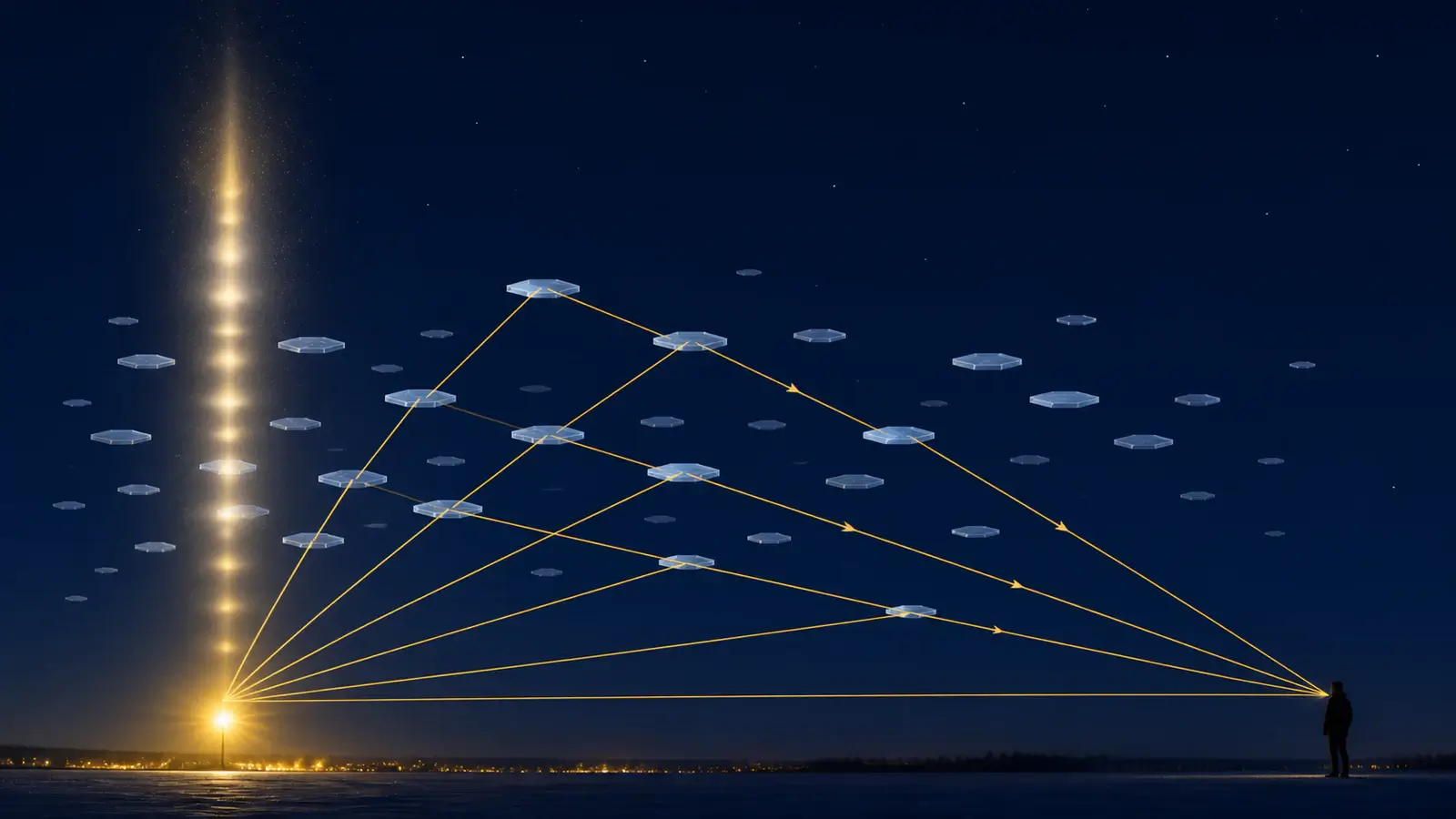
Pillars associated with the Sun are often grouped with halo phenomena, but a pillar is based primarily on reflection rather than the refraction that creates a classic 22-degree halo. Because the crystals do not form a sharp, perfect mirror, the result is stretched and diffuse. A pillar can be broken, tapered, or brighter near the light source depending on the crystal population and viewing geometry.
When are ice pillars most likely?
Cold weather is essential because the air must contain ice crystals. The most dramatic artificial-light pillars often occur on calm, bitterly cold nights when tiny crystals called diamond dust float close to the ground. Diamond dust can form under clear skies in very cold air, so a pillar display does not require an obvious snowstorm. Ice crystals falling from high clouds can also create a Sun or Moon pillar.
- Cold, ice-bearing air: the crystals must remain frozen from where they form to where they reflect the light.
- Many plate-like crystals: flat faces provide the mirror-like surfaces needed for a bright pillar.
- Light winds: gently falling crystals can keep a mostly horizontal orientation.
- A bright, unobstructed source: low Sun, Moon, streetlights, greenhouses, arenas, and industrial sites can all work.
- A favorable viewpoint: the phenomenon belongs to the observer-source geometry, another observer may see a different pillar.
Artificial pillars are especially noticeable when the source is below the observer's horizon or hidden by trees and buildings. Then the bright column seems to rise from nowhere. A dark background and clean air improve contrast, although a little haze can make a broader glow around the reflections.
Sun pillars, Moon pillars, and artificial-light pillars
| Type | Light source | Typical appearance |
|---|---|---|
| Sun pillar | The Sun, usually near sunrise or sunset | A white, yellow, orange, or red vertical streak above or below the Sun |
| Moon pillar | The Moon when it is bright enough | A pale white column, generally easier to photograph than to see |
| Artificial-light pillar | Streetlights, buildings, signs, or other ground lighting | One or many colored columns that appear to extend upward |
A Sun pillar can be observed even when the crystals are far overhead in cirrus clouds. Artificial-light pillars usually depend on crystals closer to the ground because city lights are much weaker than the Sun. A Moon pillar is possible but less common to notice because moonlight provides less contrast. The underlying reflection process is the same.
How to observe and photograph light pillars
Start by watching the forecast for clear or partly cloudy, very cold, calm nights. If tiny crystals sparkle in a flashlight beam, look toward clusters of bright lights from a safe, dark location. For a Sun pillar, look shortly before sunrise or after sunset, when the Sun itself is just below the horizon. Never stare directly at the Sun or aim magnifying optics at it.
A phone in night mode may capture a strong artificial pillar. For a camera, stabilize it, focus near infinity, and bracket exposures so bright lamps do not wash out the reflection. Include a recognizable foreground, but do not trespass or stop along an unsafe roadway. Note the time, temperature, wind, cloud cover, and direction. Those details turn an attractive picture into a useful weather observation. A home weather station can provide local temperature and wind context, although no instrument is required to enjoy the display.
If you share the image, call the phenomenon a light pillar and describe the source if you can identify it. “Ice pillar” is a widely understood informal name, but it can be confused with a physical pillar made of ice.
What light pillars are not
Light pillars are sometimes mistaken for auroras, crepuscular rays, spotlights, or vertical lightning. Auroras are emissions from the upper atmosphere and typically form moving curtains or arcs. Crepuscular rays are bands of sunlight separated by cloud shadows and widen with perspective. A spotlight beam becomes visible when particles scatter light along its path. A light pillar is seen because crystals reflect the source toward one particular observer.
They also are not the same as freezing fog. Freezing fog consists of supercooled liquid droplets that freeze onto exposed objects. Diamond dust consists of ice crystals already frozen in the air. Both favor cold conditions and can occur in the same general environment, which is one reason the terms sometimes get tangled.
Frequently asked questions
Are ice pillars rare?
They are uncommon in many populated areas because they need abundant ice crystals and favorable viewing geometry. In very cold climates, artificial-light pillars and diamond dust can be fairly regular winter sights.
Can light pillars appear without clouds?
The answer is yes. Near-surface diamond dust can form in very cold, calm air under an otherwise clear sky and reflect ground lights.
Do light pillars predict snow?
The answer is no. They confirm that ice crystals are present, but they are not a reliable forecast of snowfall at the ground.
Why are some pillars different colors?
A pillar usually carries the color of its light source. Multiple colored lamps across a town can create a row of differently colored columns.