
Weather alert field guide
What Is NOAA Weather Radio? Frequencies, SAME Alerts, and How It Works
NOAA Weather Radio provides continuous local forecasts and official hazard alerts on seven dedicated VHF frequencies, without requiring internet service.
Quick answer
NOAA Weather Radio All Hazards is a nationwide network of more than 1,000 transmitters broadcasting National Weather Service forecasts, observations, watches, warnings, and authorized emergency messages 24 hours a day. It uses seven VHF frequencies from 162.400 to 162.550 MHz. A SAME-capable alert radio can activate only for selected counties and, on compatible models, selected alert types.
NOAA Weather Radio All Hazards is a nationwide network of more than 1,000 transmitters broadcasting National Weather Service forecasts, observations, watches, warnings, and authorized emergency messages 24 hours a day. It uses seven VHF frequencies from 162.400 to 162.550 MHz. A SAME-capable alert radio can activate only for selected counties and, on compatible models, selected alert types.
What NOAA Weather Radio broadcasts
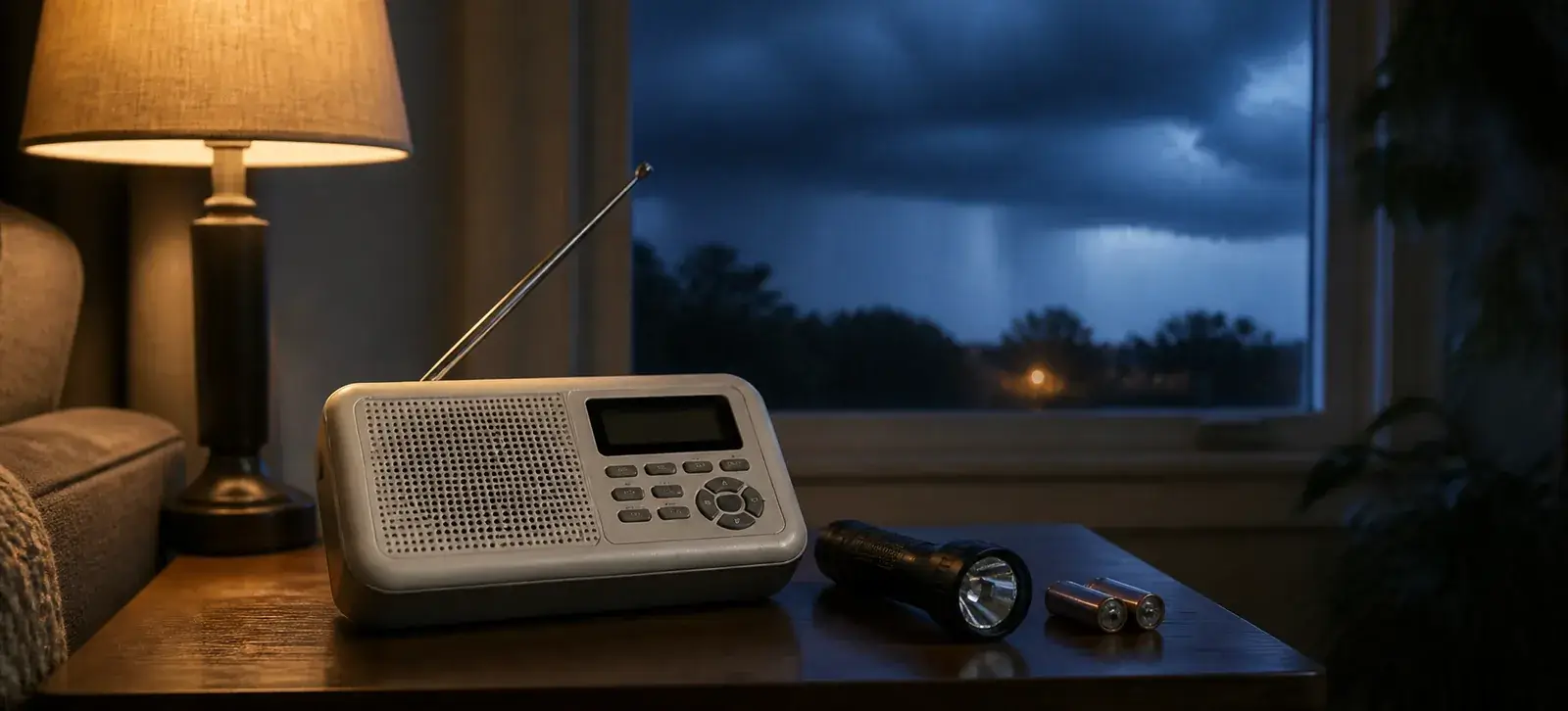
NOAA Weather Radio, commonly shortened to NWR, is the official voice of the National Weather Service. Routine broadcasts cycle through local forecasts, current conditions, climate information, and hazardous weather outlooks. When urgent information is issued, routine programming is interrupted for the warning.The system is also called NOAA Weather Radio All Hazards because authorized civil and public-safety messages can be carried along with weather warnings. The exact programming and alert suite vary by local Weather Forecast Office and transmitter.The seven NOAA Weather Radio frequencies
An ordinary AM/FM receiver cannot tune these channels. You need a weather-band receiver or scanner that covers the VHF public-service frequencies below.| Channel | Frequency | Common label |
|---|---|---|
| 1 | 162.400 MHz | WX1 on some radios |
| 2 | 162.425 MHz | WX2 on some radios |
| 3 | 162.450 MHz | WX3 on some radios |
| 4 | 162.475 MHz | WX4 on some radios |
| 5 | 162.500 MHz | WX5 on some radios |
| 6 | 162.525 MHz | WX6 on some radios |
| 7 | 162.550 MHz | WX7 on some radios |
Channel labels are not universal. Use the frequency and transmitter information supplied by your local NWS office instead of assuming every radio assigns WX1 through WX7 in the same order.
What SAME alerts do
SAME means Specific Area Message Encoding. Before an alert message, the broadcast carries a short digital header identifying the event, affected location, expiration time, and issuing authority. A programmed receiver compares that header with its saved settings and activates when they match.For a whole U.S. county, the six-digit SAME location code normally starts with 0 followed by the state and county FIPS digits. Some receivers also let you disable selected nonessential event types. Follow the receiver manual because menu names and location capacity differ by model.Weather radio, phone alert, or online stream?
| Method | Main strength | Important limitation |
|---|---|---|
| Dedicated SAME radio | Automatic local alerts without internet, battery backup is common | Requires correct frequency, location codes, and reception |
| Phone emergency alert | Portable and widely available | Depends on a charged phone, coverage, device settings, and the alert distribution path |
| Online NWR stream | Convenient for listening outside the transmitter area | Not an official substitute for a receiver, streams and internet service can fail |
| Weather-band-only radio | Receives the live broadcast | May not wake or activate automatically for warnings |
How to set up a NOAA Weather Radio
- Find the transmitter serving your location. Use the NWS county coverage and SAME-code directory or your local forecast office page and note the frequency and call sign.
- Test reception where the radio will stay. Extend the antenna and try a higher location away from electronics if the signal is noisy.
- Program the correct SAME location code. Add adjacent counties only when their warnings provide useful lead time for your location.
- Choose alert types deliberately. Keep life-safety warnings enabled and avoid disabling an event simply because it is inconvenient.
- Install backup batteries and test them. Leave AC power connected for normal use, but replace batteries on a regular schedule.
- Confirm the weekly test. Local offices generally transmit a routine test when hazardous weather will not interfere. A missed test can reveal reception, programming, or outage problems.