
Best Weather Radios for Home and Emergencies
The best weather radio is the one that reliably receives your local NOAA transmitter, wakes for the alerts you need, and still works when household power and internet service do not.

Start with the job the radio must do
A weather radio for a bedroom has a different job from a radio packed for evacuation. A dedicated desktop receiver stays connected to wall power, monitors one of the seven NOAA Weather Radio frequencies, and uses batteries when power fails. A portable emergency radio adds AM and FM reception, a flashlight, and alternate charging methods, yet its smaller controls and broad alert behavior may be less convenient for quiet overnight monitoring.
For most households, the safest buying order is a dependable dedicated alert radio first and a portable unit second. The desktop radio can remain programmed and ready every day. The portable radio can stay charged with the emergency supplies and travel when needed. Two devices also create useful redundancy if one battery, speaker, antenna, or room location fails.
The best current weather radios by use
Affiliate disclosure: WXObservation may earn a commission from qualifying Amazon purchases at no extra cost to you.

Midland WR120
The WR120 is a focused home alert radio that is easy to leave programmed, powered, and ready every day.
Best for: Households that want a dedicated plugged-in receiver with SAME filtering.
- All seven NOAA channels with SAME county programming
- Selectable voice, tone, or display alerts with color-coded warning lights
- Clock, three-AA backup, and external antenna and alert jacks
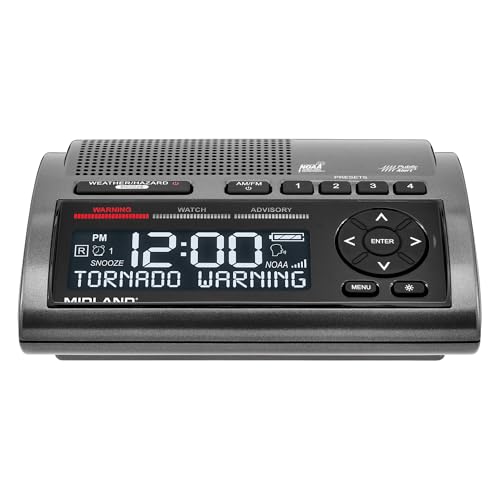
Midland WR400
The WR400 adds broader location programming, more alert choices, AM/FM reception, and useful accessory connections.
Best for: Households monitoring several counties or using external alert accessories.
- Programming for as many as 25 counties
- Four alert types, color-coded indicators, and AM/FM reception
- Four-AA backup, external antenna and alert jacks, and USB output
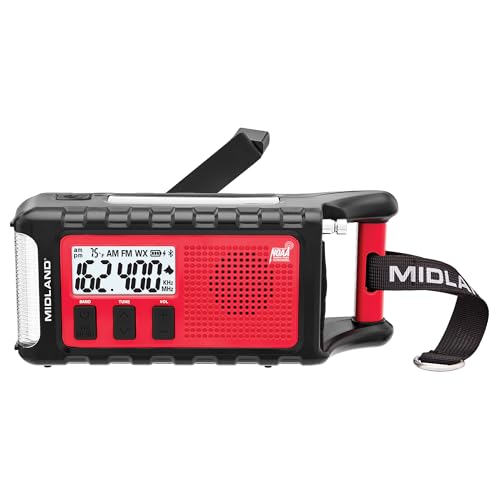
Midland ER310PRO
The ER310PRO is the high-capacity portable choice in Midland’s current line, with more reserve for lighting and limited device charging.
Best for: Emergency kits needing longer portable runtime and more phone-charging reserve.
- Replaceable 10,000 mAh lithium battery
- NOAA alerts, AM/FM, USB-C charging, and USB device output
- Solar and crank backup, flashlight, SOS beacon, and dog whistle

Midland ER40
The ER40 is Midland’s compact portable option, combining weather alerts, broadcast radio, emergency lighting, and several ways to recharge.
Best for: Small evacuation bags, vehicle kits, and users who value packability over maximum reserve.
- NOAA alerts, AM/FM, clock, and a backlit display
- Replaceable 2,600 mAh battery with USB, solar, and crank charging
- Flashlight with SOS beacon, low-battery indicator, and wrist lanyard
SAME, alert filtering, and local reception
Specific Area Message Encoding lets a compatible receiver react to alerts for selected geographic codes rather than every alert carried by the transmitter. This is valuable in a metropolitan area where one broadcast serves many counties. It reduces unnecessary alarms without changing the radio signal itself. Programming the wrong code, disabling an event, or selecting a weak channel can also prevent the alert you expected.
A portable radio may offer a weather alert mode without SAME filtering. That design can be acceptable in a travel kit because the user’s location changes and broader alerts are preferable to an old county setting. It is less pleasant beside a bed if the transmitter serves a wide region. Check the exact manual instead of assuming that every product displaying NOAA branding includes SAME.
The National Weather Service broadcasts between 162.400 and 162.550 MHz on seven channels. The radio should be tuned to the clearest local broadcast, not the channel number another reviewer uses. Place the receiver where the voice is consistently understandable. A window can help, while reinforced concrete, low interior rooms, metal roofing, and electronics can hurt. An external antenna jack is useful only when a suitable antenna and safe cable route are practical.
- Confirm the transmitter and county code on an official NWS page.
- Program only the counties and event types the household intends to monitor.
- Listen to the routine weekly test and verify the alert indicator changes.
- Repeat the test after moving the radio, changing batteries, or changing settings.
- Keep a phone alert and another independent warning path active when possible.
Plan for hours of receiving, not a few minutes of cranking
Hand cranks and small solar panels are valuable last-resort tools. They are inefficient ways to refill a large modern phone, and their output depends on speed, sunlight, battery condition, and conversion losses. Treat them as methods for restoring enough energy to hear a forecast, use a light briefly, or make a short call. Begin an outage with the radio fully charged and spare batteries available.
A dedicated radio should have fresh backup batteries even though it normally uses wall power. Label the battery replacement month and inspect for leakage. A portable radio with a lithium battery should be recharged on a schedule rather than forgotten for years. Store a separate USB power bank because using the radio as a phone charger consumes the same reserve needed for alerts and light.
Cold and heat reduce useful battery performance. Avoid leaving the only emergency radio in a vehicle through extreme seasons. If a vehicle unit is useful for the household, rotate it indoors for charging and inspection. Keep charging cables with the radio, including the connector required by the household’s current phones.
A ten-minute setup that matters more than extra features
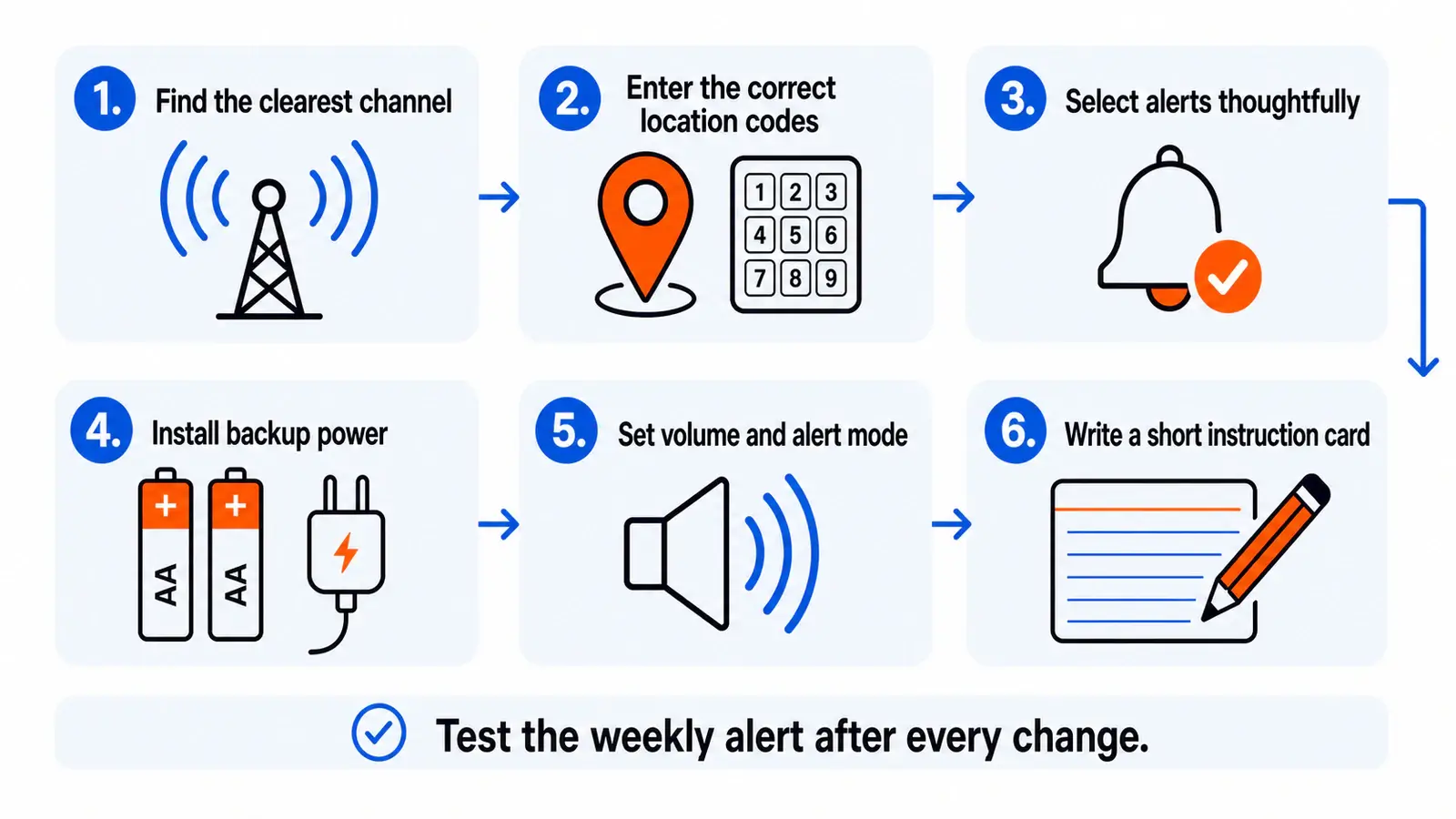
- Find the clearest channel. Extend the antenna and listen from the permanent location.
- Enter the correct location codes. Use official county or independent-city codes rather than a retailer list.
- Select alerts thoughtfully. Keep life-safety warnings enabled and avoid aggressive filtering until the weekly test succeeds.
- Install backup power. Use the battery type in the manual and confirm the radio stays on when wall power is removed.
- Set volume and alert mode. Test from the bedroom or occupied room with doors closed.
- Write a short instruction card. Record the channel, county code, battery type, and basic silence procedure for other household members.
A weather radio does not interpret risk for your property. A warning may cover only part of a county, and a transmitter can experience an outage. The receiver should sit inside a broader plan that includes a known safe place, charged phones, flashlights, medications, and a way to receive local instructions.
Frequently asked questions
Does a NOAA weather radio work without internet or cell service?
Yes. It receives a dedicated VHF broadcast directly from a National Weather Service transmitter. Internet and cellular service are not required for basic reception, although some radio features or separate apps may use them.
Is SAME required?
SAME is not required to hear forecasts or alerts. It is valuable for a stationary home receiver because it can filter alerts by selected geographic codes. A broad portable alert receiver can still be useful when traveling.
Will a crank weather radio charge a smartphone?
Some models can provide limited USB power, but crank and small-panel charging should be treated as emergency maintenance. A charged standalone power bank is a much better primary phone reserve.
How often should the radio be tested?
Listen for routine reception regularly and use the weekly NWS test when available. Recheck after settings, batteries, antennas, room location, or nearby electronics change.
Sources and further reading
- National Weather Service — NOAA Weather Radio receiver information
- National Weather Service — SAME and coverage
- Midland — WR120 full user guide
- Midland — WR400 full user guide
- Midland — ER310PRO owner manual
- Midland — ER40 full user guide
Compare weather radios, lightning detectors, cross-brand field meters, and Kestrel models in one place.