
Lightning safety guide
The 30-Minute Lightning Rule: When Is It Safe to Go Back Outside?
Go inside when you hear thunder, then wait at least 30 minutes after the final rumble. Every new thunderclap restarts the clock.
Quick answer
When you hear thunder or see nearby lightning, stop outdoor activity and enter a substantial building or an enclosed metal-topped vehicle with the windows up. Remain there for at least 30 minutes after the last thunder or visible lightning. Any new thunder or lightning restarts the full 30-minute wait. Rain ending, blue sky appearing, or radar showing the core moving away does not shorten the rule.
Lightning safety has two separate decisions: when to go inside and when to return. The first is immediate—if thunder is audible, lightning is close enough to strike. The second is deliberately patient. Storms can produce dangerous cloud-to-ground flashes after the heaviest rain and even when part of the sky looks brighter.
The 30-minute rule gives families, coaches, workers, and event organizers one clear standard instead of asking an untrained observer to judge whether a particular storm has become “far enough away.”
How the 30-minute lightning rule works
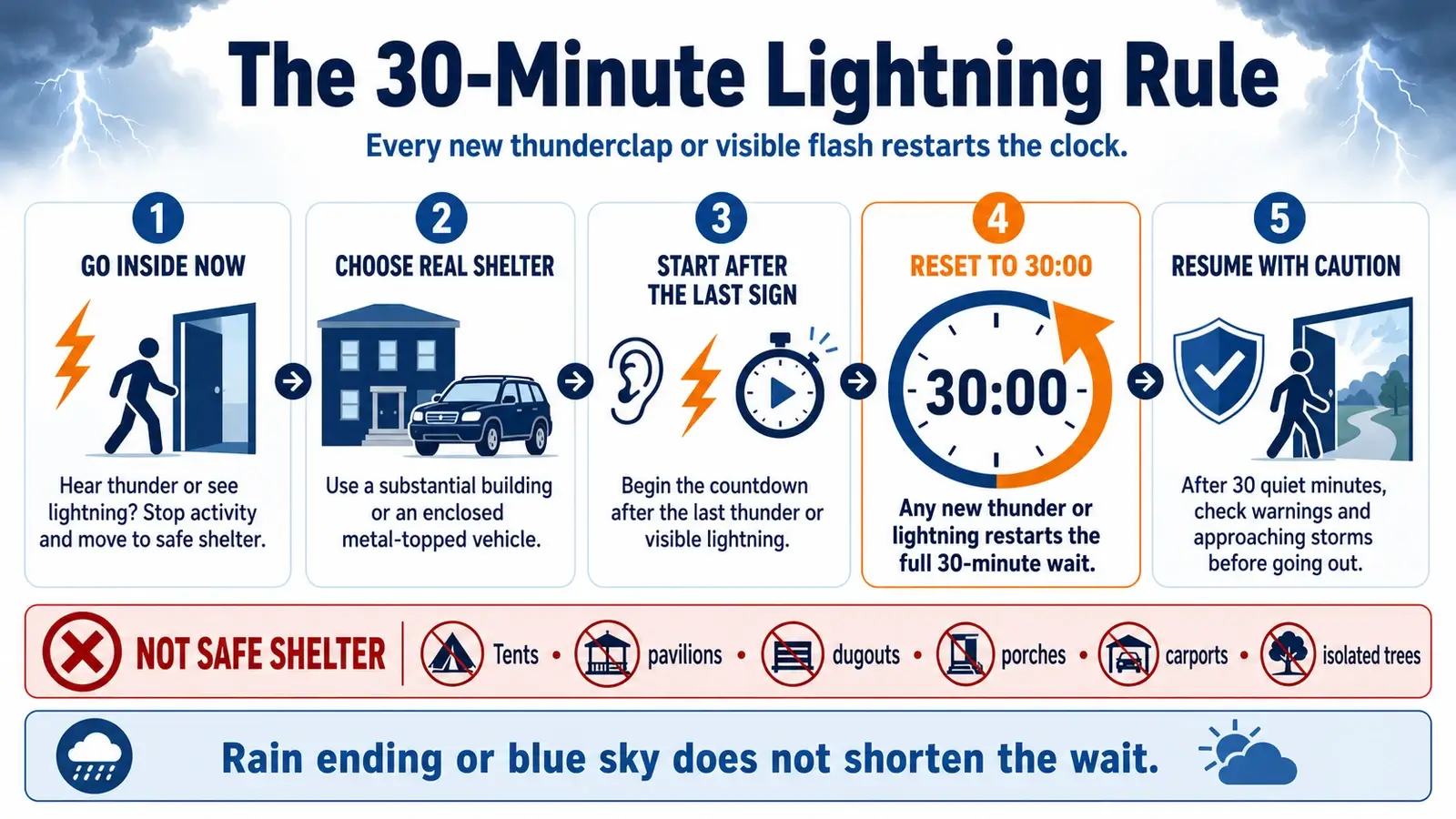
- Respond to the first thunder. Suspend play or work and move everyone toward safe shelter. Do not wait for visible lightning, hard rain, or an official warning.
- Note the most recent thunder or lightning time. One responsible person should run the clock so a group does not rely on conflicting estimates.
- Wait inside for 30 complete minutes. The countdown starts after the most recent thunder or visible lightning, not when people enter the building.
- Reset when the threat reappears. Any new thunder or visible lightning during the wait returns the timer to 30:00.
- Reassess before resuming. If warnings remain active or another storm is approaching, continue sheltering even after 30 quiet minutes.
The phrase once commonly taught as “when thunder roars, go indoors” remains a useful memory aid. The important operational detail is that indoors means a genuinely safer enclosure, not merely getting beneath a roof.
Why wait 30 minutes after the last thunder?
Lightning is not confined to the darkest rain shaft. A bolt can travel outward from a storm and strike where little or no rain is falling. The National Weather Service notes that lightning can strike more than 10 miles from a thunderstorm, roughly the distance at which thunder may still be heard under favorable conditions. If you can hear the storm, you are already inside its potential strike range.
The back side of a storm remains hazardous too. Lightning frequency may decline as the rain moves away, but a less active storm is not a lightning-free storm. A 30-minute quiet interval gives the electrically active portion time to move farther away or weaken before people spread across an exposed field, pool deck, construction site, or trail.
The rule is conservative by design. Thunder audibility changes with wind, terrain, buildings, and background noise. A busy stadium may not hear every distant rumble. Thirty minutes does not guarantee that lightning is physically impossible. It provides a simple minimum recommended by the National Weather Service and lightning-safety organizations. Continue waiting when official warnings, visible lightning, or detection data show a continuing threat.
What counts as safe lightning shelter?
The preferred shelter is a substantial building with electrical wiring or plumbing, such as a home, school, office, store, or enclosed recreation center. These systems help carry current through conductive paths rather than through a person, although occupants still need to avoid contact with those paths during the storm.
The practical second choice is an enclosed, metal-topped vehicle with the windows closed. The metal shell—not the rubber tires—helps route current around the occupants. Convertibles, golf carts, open utility vehicles, motorcycles, bicycles, and vehicles with open cabs do not provide the same protection.
| Place | Safe lightning shelter? | Why |
|---|---|---|
| Substantial enclosed building | Yes, preferred | Wiring, plumbing, and structure provide safer conductive paths |
| Enclosed metal-topped vehicle | Yes, good alternative | Metal shell can conduct current around occupants |
| Picnic pavilion or dugout | No | Open sides expose people to side flashes and ground current |
| Tent or fabric canopy | No | Provides rain cover but no lightning protection |
| Small shed or bus shelter | Generally no | Often lacks substantial construction and protective systems |
| Under a tree | No | A strike can jump from the tree or travel through roots and ground |
If no safe shelter is available, there is no risk-free outdoor option. Move away from isolated tall objects, ridges, open water, metal fences, and groups of people while seeking a substantial building or vehicle. Do not lie flat. That increases contact with ground current. Prevention—checking the forecast and identifying shelter before activity begins—is far safer than improvising after thunder starts.
Lightning safety while you are indoors
Entering a building greatly lowers risk, but lightning can travel through plumbing, wiring, corded communications, and conductive building materials. During the storm and the 30-minute wait:
- Avoid showers, sinks, faucets, and other plumbing.
- Do not use corded phones or equipment connected directly to an outlet.
- Stay away from windows, exterior doors, porches, and attached open garages.
- Do not lean on concrete walls or lie on concrete floors, which may contain metal reinforcement.
- Use mobile phones and battery-powered devices rather than plugged-in electronics.
It is better to unplug valuable electronics before storms arrive. Do not handle cords or reach behind equipment during active lightning. Surge protectors can reduce some electrical damage but do not make it safe to use a wired device during a nearby storm.
Using the rule for sports, pools, schools, and outdoor work
A useful lightning plan is written before the event. Identify shelters, calculate how long the farthest participant needs to reach them, assign one person to monitor weather, and define who can suspend and resume activity. The suspension trigger must occur early enough for everyone to be inside by the time the storm arrives.
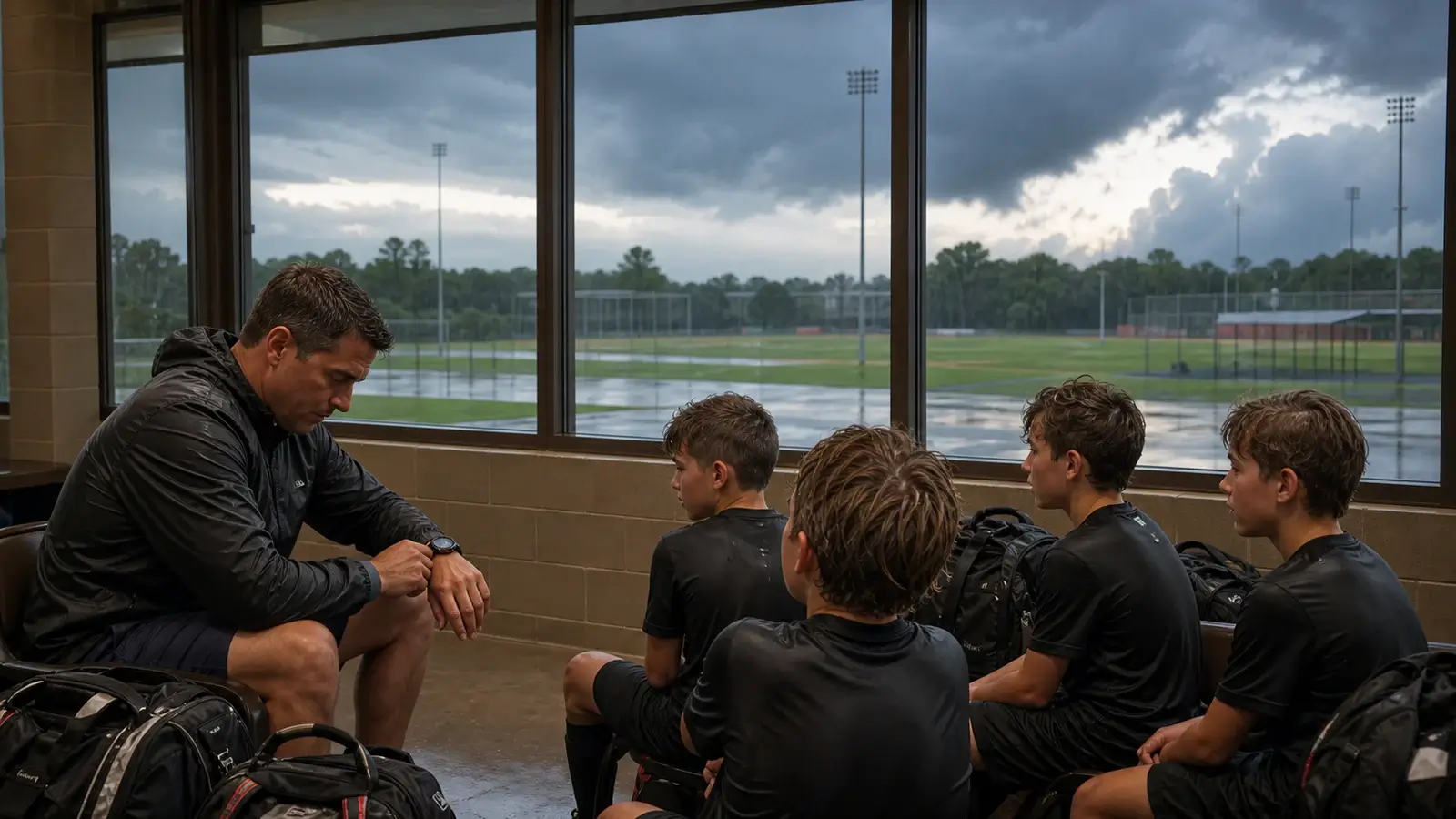
For a youth game, record the last thunder time where coaches and officials can see it: “Last thunder 4:12 p.m., earliest possible return 4:42 p.m.” A rumble at 4:31 changes the sign to 5:01. This removes pressure to negotiate the final few minutes and makes the same rule apply to both teams.
Pool decks, beaches, golf courses, and open fields need especially early action because evacuation can take time. Lifeguards should clear water and the surrounding deck. Workers should leave cranes, scaffolding, roofs, and exposed machinery. A nearby lightning detector can add situational awareness, but hearing thunder is already enough to shelter. See how lightning detection systems work.
Do not use rainfall as the all-clear. Lightning can occur before rain begins and after it ends. Likewise, the popular “heat lightning” label does not identify a harmless type of lightning—it is usually ordinary distant lightning whose thunder is too far away to hear. Our heat lightning guide explains the effect.
The rule in one sentence
At the first thunder or visible lightning, enter a substantial building or enclosed metal-topped vehicle and remain there until at least 30 minutes after the last thunder or lightning.
Frequently asked questions
Does the 30-minute clock start when the rain stops?
The answer is no. It begins after the last thunder you hear. Rain can stop while the storm is still producing dangerous lightning.
What if I see lightning but do not hear thunder?
Treat visible nearby lightning as a warning and seek shelter, especially if the storm is approaching or background noise may be masking thunder. Do not wait to prove the exact distance.
Is a car safe during lightning?
An enclosed metal-topped vehicle with windows closed is a good alternative shelter. Avoid touching metal connected to the exterior. Convertibles, golf carts, motorcycles, and open vehicles are not equivalent.
Can I leave shelter exactly 30 minutes after the last thunder?
Thirty minutes is the minimum. Continue sheltering if a warning remains active, lightning is still visible nearby, or another storm is approaching.
Sources and further reading
- National Weather Service: Lightning safety overview
- National Weather Service: Lightning safety for organized sports
- National Weather Service: Lightning safety outdoors
- National Weather Service: Lightning safety tips and resources
Reviewed against current National Weather Service, NOAA, and volunteer-observer guidance on August 7, 2026.